It’s 11:47 p.m. Your partner said they’d text after their thing ended. It’s been three hours. Your thumb has hovered over their name in your messages four times now. You’ve already written and deleted “hey, everything okay?” twice. Your chest feels tight, your mind is running a highlight reel of every way this could mean something’s wrong, and some small, exhausted part of you is thinking: why does this always happen to me.
If any part of that felt uncomfortably specific, you’re not “too sensitive,” you’re not “crazy,” and you’re not broken. You’re very likely living with an anxious attachment style — one of the most common relationship patterns there is, and one of the most misunderstood.
Most articles on this topic will hand you a clinical definition, a bullet list of “signs,” and a vague nod toward therapy. That’s the ceiling most guides stop at. This one goes further: what anxious attachment actually feels like in your body in real time, where it comes from, what the research says about its effects, and — most importantly — an actual toolkit for what to do the next time you feel the spiral start. If you want a fast, structured way to see where you personally land before reading further, our free attachment style quiz takes about two minutes and gives you a clearer starting point than most people get from years of guessing.
What Is Anxious Attachment Style, Exactly
Anxious attachment style is a relationship pattern built around one core fear: that the people you love most could leave, and you won’t see it coming. It shows up as a strong craving for closeness paired with a nervous system that stays on high alert for any sign that closeness is slipping away.
This isn’t a personality quirk or a character flaw. It’s a survival strategy your nervous system built, usually in early childhood, in response to caregiving that felt inconsistent — sometimes warm and attuned, sometimes distracted, distant, or unpredictable. As a child, staying hyper-alert to a caregiver’s mood and amplifying your bids for attention (crying louder, clinging harder, needing constant reassurance) was often the most effective way to get your needs met. That strategy worked well enough to become wired in. Decades later, it’s still running — just now it’s aimed at a romantic partner instead of a parent.
Anxious attachment is one of the three insecure attachment styles identified in attachment theory, alongside avoidant attachment and disorganized (fearful-avoidant) attachment, with secure attachment as the fourth, healthiest pattern. Research estimates that roughly one in five adults has a predominantly anxious attachment style, making it one of the most common relational patterns in adult romantic life — not a rare or unusual struggle.
Where Anxious Attachment Style Actually Comes From
Attachment theory traces back to psychiatrist John Bowlby and psychologist Mary Ainsworth, whose research in the mid-20th century found that infants develop different strategies for handling separation from a caregiver, depending on how consistently that caregiver responded to their needs.
Anxious attachment style typically develops from what researchers call inconsistent or misattuned caregiving. This doesn’t necessarily mean neglect or abuse — often it’s far subtler than that. A parent who was warm and present some days, but stressed, distracted, or emotionally unavailable on others, unintentionally teaches a child that love and attention are unpredictable. The child never quite knows which version of their caregiver they’ll get, so they learn to stay hyper-vigilant, reading moods and adjusting behavior in an effort to secure connection before it disappears.
Other common contributing factors include:
- A caregiver whose own emotional needs sometimes came before the child’s, creating a subtle role reversal
- Early experiences of separation, loss, or family instability
- A household where affection had to be “earned” through good behavior or achievement
- Growing up as the emotional support for a parent, rather than the other way around
None of this is about assigning blame to anyone’s upbringing. It’s about understanding that anxious attachment style is a learned response to real circumstances — which is exactly why, with the right awareness and practice, it can be unlearned.
The Real-Time Experience: What Anxious Attachment Actually Feels Like
This is the part most clinical breakdowns skip entirely, and it’s often the most useful part to actually read.
Anxious attachment style isn’t just a set of behaviors — it’s a full-body physiological state. When something happens that your nervous system interprets as a threat to connection (a delayed reply, a shorter-than-usual “goodnight,” a partner seeming distracted), your body can genuinely shift into a fight-or-flight response. Heart rate increases. Thoughts start racing. There’s an urgent pull to do something — check their location, reread old messages, ask “are we okay?” for the third time this week — because the discomfort of not knowing feels unbearable.
This is why “just don’t worry about it” has never once worked as advice. You’re not choosing to feel this way. Your nervous system is reacting the way it learned to react a long time ago, faster than conscious thought can intervene. Understanding that distinction — this is a nervous system response, not a character flaw — is often the single biggest relief people with anxious attachment style describe when they first learn about the pattern.
Common Signs of Anxious Attachment Style
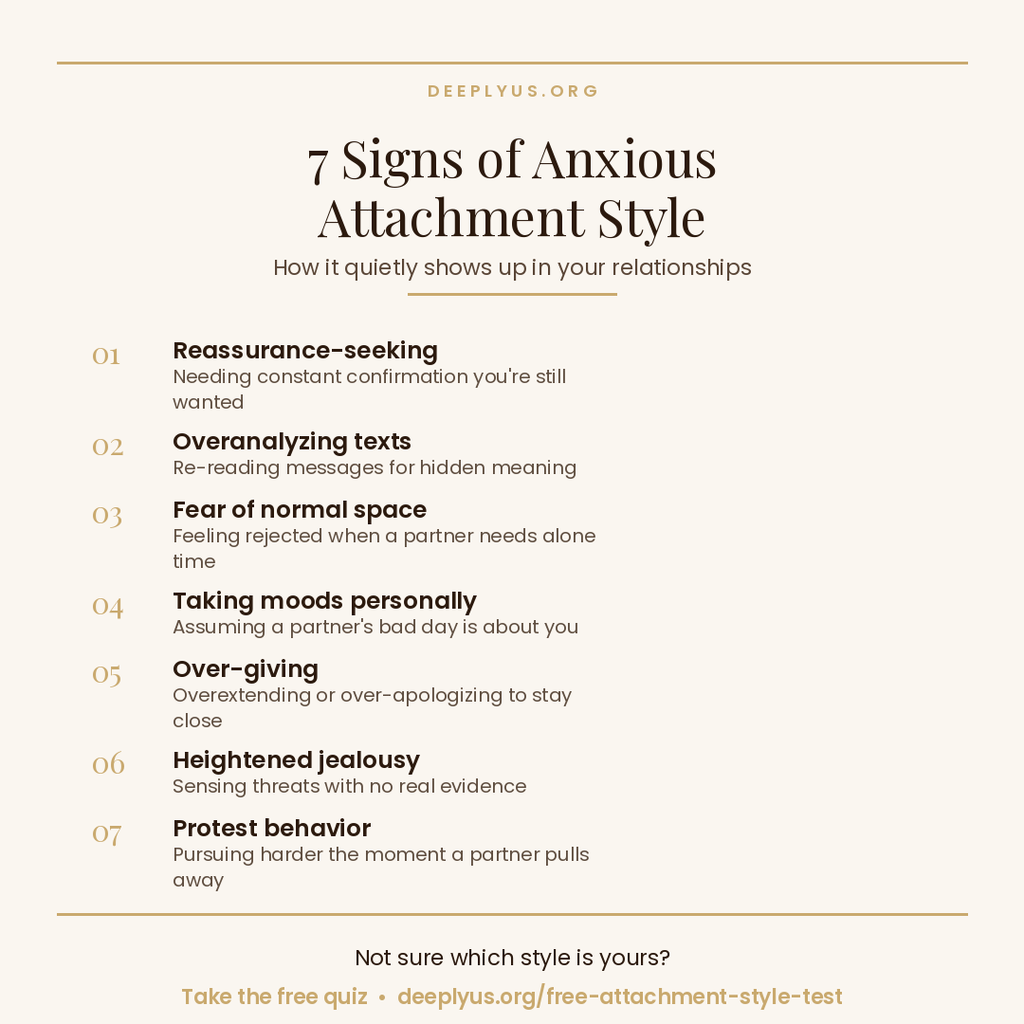
Anxious attachment style can show up differently from person to person, but the underlying thread is almost always the same: a deep desire for closeness paired with a persistent fear that it isn’t secure. Common signs include:
- Frequently re-reading texts or conversations looking for hidden meaning
- Needing regular reassurance that a partner still loves or wants you
- Feeling panicked or rejected when a partner needs normal, everyday space
- Interpreting a partner’s bad mood, tiredness, or distraction as being about you
- Difficulty enjoying time alone without thoughts of the relationship intruding
- A tendency to over-give, overextend, or over-apologize to avoid conflict
- Jealousy or a heightened awareness of perceived “threats” to the relationship, even without clear evidence
- Choosing emotionally unavailable partners, then working hard to “earn” consistent love
- Sudden mood shifts based on a partner’s tone, response time, or body language
- A strong urge to protest, escalate, or pursue when a partner pulls away
If several of these sound familiar, that’s information, not a diagnosis — and it’s genuinely common. Anxious attachment style exists on a spectrum, and most people recognize themselves in some, not all, of these patterns.

What the Research Actually Says
This is a subject with real research behind it, not just pop-psychology talking points. A large body of attachment research, including a widely cited meta-analysis spanning over 200 studies, has found a consistent link between attachment anxiety and higher rates of anxiety symptoms, low mood, and loneliness. This doesn’t mean anxious attachment style is a mental health disorder — it isn’t, and it’s not a clinical diagnosis — but it does mean the pattern has measurable effects on emotional wellbeing beyond just romantic relationships.
Research also consistently shows two encouraging findings. First, attachment style is not fixed for life. Psychologists use the term “earned secure attachment” to describe the well-documented shift that happens when someone with an insecure attachment style — anxious or avoidant — builds enough self-awareness and corrective relationship experience to develop more secure patterns over time. Second, insight alone rarely creates that shift. What actually moves the needle is consistent practice: naming the pattern in real time, learning to self-regulate instead of immediately seeking external reassurance, and — where possible — being in a relationship with a partner who can respond with steadiness rather than matching the anxiety.
Anxious Attachment Style in Romantic Relationships
This is where anxious attachment style tends to show up most intensely, because romantic relationships involve exactly the kind of emotional closeness and vulnerability that activates the pattern.
In practice, this often looks like a specific, repeating cycle. Something small happens — a delayed reply, a shorter text than usual, a partner seeming distracted during a conversation. The anxious partner’s alarm system activates, and the instinct is to seek reassurance quickly: a follow-up text, a call, a direct question about the relationship’s status. If the partner responds warmly, the anxiety usually settles, at least for a while. If the partner seems distant, busy, or needs space — which is often completely unrelated to the relationship — the anxious partner tends to interpret that as confirmation of the underlying fear, and reaches harder.
This dynamic is especially pronounced when an anxious attachment style is paired with an avoidant attachment style in the same relationship, which happens more often than most people realize. The anxious partner’s pursuit can trigger the avoidant partner’s instinct to withdraw, which in turn intensifies the anxious partner’s fear of abandonment — creating a loop that neither partner started on purpose and neither can easily see from the inside.
Here’s what that exchange often sounds like without any awareness of the pattern:
Anxious partner: “You’ve barely texted me all day, is something wrong?”
Avoidant partner: “I’m fine, just busy. Can we talk later?”
Anxious partner (hearing “later” as “never”): “You always do this. The second I bring something up you shut down.”
Neither person is lying, and neither is the villain. But without understanding the pattern, both walk away feeling misunderstood. This is exactly the kind of recurring conflict our Anxious Attachment Toolkit was built to address, with word-for-word scripts for the moment the spiral starts, instead of generic advice to “just communicate better.”
Anxious Attachment Style Beyond Romance: Friendships, Family, and Work
Almost every article on this topic focuses exclusively on romantic relationships, but anxious attachment style doesn’t switch off outside of dating. The same underlying fear of disconnection can show up in:
- Friendships: overanalyzing a friend’s slower-than-usual reply, feeling hurt when not included in plans, needing frequent check-ins to feel secure in the friendship
- Family relationships: a persistent need for a parent’s or sibling’s approval, difficulty setting boundaries for fear of causing distance
- Work relationships: anxiety around a manager’s tone in an email, over-checking for feedback, difficulty tolerating ambiguity about how you’re perceived professionally
Recognizing this wider pattern matters, because it reframes anxious attachment style as a nervous system tendency rather than something specific to romantic dysfunction — which also means the tools for managing it apply far beyond your relationship.
Anxious vs Avoidant vs Secure vs Disorganized: A Quick Comparison
| Anxious | Avoidant | Secure | Disorganized | |
|---|---|---|---|---|
| Core fear | Abandonment | Engulfment | Neither dominates | Both, simultaneously |
| Under stress | Pursues, seeks reassurance | Withdraws, needs space | Communicates directly | Oscillates unpredictably |
| View of self | “I’m not enough” | “I don’t need anyone” | “I’m worthy of love” | Fragmented, inconsistent |
| View of others | “They might leave” | “They want too much” | “People are generally trustworthy” | Unpredictable, sometimes threatening |
| Healing direction | Building self-soothing and secure independence | Learning to stay present and express need | Maintaining existing patterns | Building safety and consistency first |
Seeing anxious attachment style laid out next to the others makes something important clear: it’s not “more emotional” or “worse” than avoidant attachment. It’s a different strategy for managing the exact same underlying fear — not feeling fully safe in connection.
How to Actually Stop the Spiral: A Real-Time Toolkit
This is the part almost no other guide gives you. Understanding anxious attachment style intellectually is step one. Interrupting it in the actual moment it’s happening is the far more useful skill — and it’s learnable.
In the moment (the next five minutes)
- Name it out loud, even just to yourself. “This is my anxious attachment activating, not necessarily reality” creates a small but real gap between the feeling and the reaction.
- Delay the urge to reach out by 20 minutes. Set a timer if you need to. Most urges to send a follow-up text lose intensity once the initial spike passes.
- Regulate your body before you regulate the situation. Slow, extended exhales (longer than your inhale) signal safety to your nervous system faster than any amount of reasoning.
- Write the anxious thought down instead of sending it. Getting it out of your head and onto paper often reveals how much of it is fear-based story rather than fact.
Within the hour
- Ask yourself what you actually know, versus what you’re assuming. Often the honest answer is “I know they haven’t replied yet” — everything after that is a story your nervous system is filling in.
- Do something that requires your hands or body. A walk, cleaning, cooking — anything that pulls attention out of your head and into the present moment.
- Reach out with a need, not an accusation. “I’m feeling anxious and could use a quick reassurance” lands very differently than “you never text me back.”
As an ongoing practice
- Build a self-soothing toolkit before you need it, so you’re not trying to invent one mid-spiral: a playlist, a breathing pattern, a friend you can call, a journal prompt you return to.
- Track your patterns. Many people with anxious attachment style notice their spirals cluster around specific triggers — certain times of day, certain topics, certain kinds of silence. Naming your specific pattern makes it far easier to catch early.
- Practice tolerating small amounts of uncertainty on purpose. Confidence that you can survive not knowing is built gradually, not all at once.
What to Say to a Partner With Anxious Attachment Style
If you’re the partner of someone with anxious attachment style, small, consistent signals of reliability go much further than grand reassurances. A few things that genuinely help:
- Give a timestamp instead of vague reassurance: “I’ll text you back after my meeting around 3” lands more calmingly than “I’ll get to it eventually.”
- Follow through on small commitments consistently — reliability, not intensity, is what builds felt security over time.
- When your partner seeks reassurance, resist the urge to say “you’re overreacting.” Even if the trigger seems small, the fear underneath it is real to them.
- Ask directly what would help in that specific moment, rather than guessing.
None of this means walking on eggshells forever. As trust builds and the anxious partner develops better self-soothing skills, the frequency and intensity of these moments typically decreases substantially.
Can Someone With Anxious Attachment Style Have a Healthy, Secure Relationship
Yes — and this deserves to be said clearly, because a lot of content on this topic leans heavily into the difficulty of anxious attachment without ever landing on the genuinely good news: this pattern is one of the more responsive to change, especially with the right partner and the right tools.
Movement toward secure attachment typically involves:
- Building a stronger relationship with self-soothing, so reassurance from a partner becomes a nice-to-have rather than an urgent need
- Learning to separate a partner’s normal need for space from an actual threat to the relationship
- Practicing direct communication of needs instead of protest behavior (chasing, guilt-tripping, testing)
- Where possible, being in a relationship with a partner capable of consistent, predictable responsiveness — which is often the single biggest accelerant toward earned secure attachment
This is also, not coincidentally, exactly what our Anxious Attachment Toolkit was built to support. If you want a lighter, ongoing way to build closeness alongside that work, our Date Night Cards — 52 Conversation Prompts for Couples give you one guided conversation a week, moving gradually from light to vulnerable, which is a genuinely effective way to build the kind of predictable connection that calms an anxious attachment style over time.
Inside the Anxious Attachment Toolkit: Heal Your Anxiety and Reach Your Avoidant Partner
Everything covered so far in this guide — the real-time spiral toolkit, the scripts for reaching out without accusation, the understanding of what your partner needs to hear versus what your fear wants to say — is exactly what we built into the Anxious Attachment Toolkit — Heal Your Anxiety & Reach Your Avoidant Partner.
It’s designed specifically for the anxious partner in an anxious-avoidant pairing, because generic relationship advice rarely accounts for how differently these two nervous systems experience the same conflict. Inside, you’ll find:
- A guided breakdown of your specific anxious triggers, so you can catch the spiral earlier each time instead of only recognizing it in hindsight
- Word-for-word scripts for reaching out to an avoidant partner in a way that invites closeness instead of triggering withdrawal
- Self-soothing exercises built for the exact moments covered in this guide — the delayed reply, the short text, the sudden silence
- A framework for understanding what your avoidant partner’s withdrawal actually means (and doesn’t mean), so you’re reacting to reality instead of fear
- A structured path toward earned secure attachment, so the goal isn’t just calming today’s spiral, but needing fewer of them over time
If this article described your relationship a little too accurately, this toolkit is the practical next step — built to turn the insight above into something you can actually use the next time your phone stays quiet for longer than you’d like.
When to Consider Professional Support
Self-awareness and practice go a long way, but anxious attachment style isn’t something everyone needs to — or should try to — untangle entirely alone. It’s worth considering therapy, particularly attachment-focused or emotionally focused therapy, if:
- The anxiety significantly affects your daily functioning, sleep, or ability to concentrate
- You notice the pattern repeating across nearly every relationship, romantic or otherwise
- Past experiences of loss, instability, or trauma feel connected to your current relationship fears
- You want deeper, guided work on the childhood roots of the pattern
Seeking support for this isn’t a sign that self-help tools have failed — it’s simply a different, complementary layer of the same work.
Frequently Asked Questions About Anxious Attachment Style
What causes anxious attachment style? It typically develops from inconsistent or unpredictable caregiving in early childhood — a caregiver who was sometimes warm and attuned, and other times distracted, stressed, or emotionally unavailable, making love and attention feel unreliable.
Is anxious attachment style the same as being needy? No. Anxious attachment style is a nervous system response to a genuine fear of disconnection, not a personality trait or a lack of self-control. Reframing it this way is often the first step toward managing it with more compassion for yourself.
Can anxious attachment style change over time? Yes. Researchers refer to this shift as earned secure attachment, and it’s well documented. It typically requires consistent self-awareness, practiced self-regulation skills, and — ideally — relationship experiences that offer reliable, predictable responsiveness over time.
Does anxious attachment style only affect romantic relationships? No. While it’s most intensely felt in romantic relationships, the same underlying pattern can show up in friendships, family dynamics, and even professional relationships.
What’s the difference between anxious attachment and anxiety disorders? Anxious attachment style is a relational pattern, not a clinical diagnosis. It can coexist with anxiety disorders, and research links attachment anxiety with higher rates of general anxiety symptoms, but they are not the same thing, and one does not require the other.
How do I know if I have an anxious attachment style? The signs above (constant reassurance-seeking, high emotional reactivity to distance, difficulty with a partner’s independence) are common indicators, but a structured assessment is far more reliable than self-diagnosis. Our free attachment style quiz is built specifically to give you clarity in a couple of minutes.
Can two anxiously attached people be in a relationship together? Yes, though it often comes with its own dynamic — both partners may seek high levels of reassurance and closeness, which can feel validating but can also amplify each other’s anxiety during conflict if neither has strong self-soothing skills yet.
What’s the fastest way to calm an anxious attachment spike in the moment? Slow, extended exhales paired with delaying any reach-out by even 15 to 20 minutes is one of the most immediately effective tools, since it gives the physiological spike time to pass before you act from inside it.
The Bottom Line
Anxious attachment style isn’t a flaw in your character, and it isn’t a life sentence. It’s a survival strategy your nervous system built a long time ago, in response to real circumstances, to protect something that mattered deeply: staying connected to the people you loved. That strategy made sense once. It doesn’t have to run the show forever.
The path forward isn’t about becoming someone who never feels anxious in relationships again — it’s about building enough self-awareness and self-soothing capacity that the anxiety no longer drives the relationship. That shift is genuinely achievable, and it usually starts with the same first step: understanding your own pattern clearly enough to catch it before it catches you.
If you’re ready to take that first step, start with our free attachment style quiz to see exactly where you land, then explore the Stop Miscommunication System for the full toolkit — including the Anxious Partner Toolkit and word-for-word scripts — built specifically for turning this understanding into real, lasting change in your relationship.