The Free Attachment Style Test
That Scores All Four Styles
Most tests only score anxious and avoidant. There are actually four distinct attachment styles — and knowing exactly which one you have changes everything about how you relate in relationships.
Answer honestly. Not how you wish you were — how you actually are.
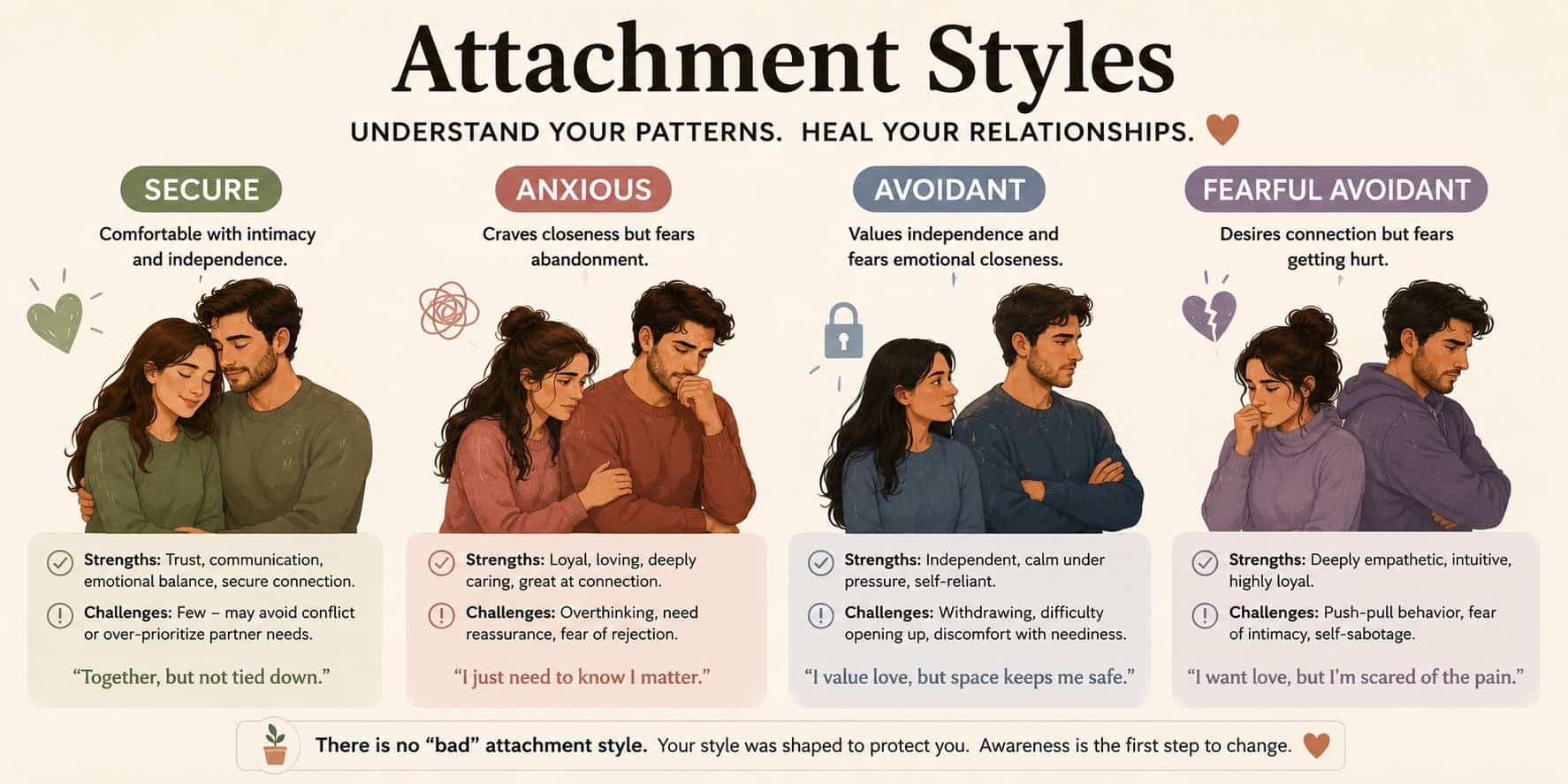
If you have been asking yourself “what is my attachment style?” — this free attachment style test gives you the most complete answer available online. It measures all four attachment styles accurately — secure, anxious, avoidant, and fearful-avoidant — with scored results and a personalised breakdown of what your pattern means for your relationship right now. Unlike most tests, this one does not force you into a single category. All four are scored independently.
Answer honestly — not how you wish you were, but how you actually are.
What is my attachment style — and how do I find out?
If you have been asking yourself “what is my attachment style?” — taking a structured attachment style test is one of the most reliable ways to find out. Attachment style is not always obvious from self-reflection alone, because the patterns it creates feel normal from the inside. You may not recognise your anxious attachment until you see the reassurance loop named clearly. You may not recognise your avoidant attachment until you see the withdrawal pattern described from the outside. An attachment style test gives you that outside view.
This free attachment style test uses 40 questions scored across all four styles independently. Rather than assigning you a single label, it shows you your full scored profile — so you can see not just your primary attachment style but any secondary patterns you carry. If you have ever wondered “what is my attachment style really?” — your result from this test is the most accurate free answer available.
What are the attachment styles?
There are four attachment styles identified by attachment theory: secure, anxious, avoidant, and fearful-avoidant. Most people have one primary attachment style with some secondary traits from another. Understanding what the attachment styles are — and which one you carry — is the foundation for understanding almost every recurring pattern in your relationship.
The four attachment styles differ primarily in how safe closeness feels, how a person responds to perceived threats of disconnection, and how they regulate emotional intensity in close relationships. This attachment style test scores all four, giving you a complete picture rather than forcing you into a binary choice.
What is an avoidant attachment style?
An avoidant attachment style is characterised by a high value placed on independence combined with discomfort around emotional intensity and closeness. People with avoidant attachment tend to withdraw when relationships become emotionally demanding — not from indifference, but because closeness was associated early in life with burden, pressure, or emotional unavailability from caregivers.
The avoidant attachment style shows up in relationships as emotional distance, difficulty accessing feelings in real time, a preference for processing things alone, and withdrawal during conflict. Partners of people with avoidant attachment often experience this withdrawal as rejection or abandonment, even when the avoidant partner does not intend it that way. This misread is at the core of the anxious-avoidant dynamic — the most common and most painful relationship pattern. Read more: How to make an avoidant partner open up.
This attachment style test includes 10 questions specifically targeting avoidant attachment indicators — so if this is your primary style, your result will reflect that clearly.
What is an anxious attachment style?
An anxious attachment style is characterised by a high need for closeness combined with a persistent fear that it will be taken away. People with anxious attachment tend to monitor their relationship closely for signs of disconnection, need more reassurance than their partner naturally provides, and can pursue harder when their partner pulls away — which often has the opposite effect to what they need.
The anxious attachment style develops when early caregiving was loving but inconsistent or emotionally unpredictable. The child learned that love was available but not guaranteed — so they built a monitoring system that stayed permanently alert. That system follows the person with anxious attachment into every adult relationship they have, creating the reassurance loop, the spiral, and the pursuit behaviour that most people with this style recognise immediately.
This attachment style test includes 10 questions specifically for anxious attachment indicators. If anxious attachment is your primary pattern, your result will include specific information about your triggers, your conflict behaviour, and what actually changes the pattern. Read more: Signs you have an anxious attachment style in relationships.
What is an attachment style test?
An attachment style test is a scored psychological assessment that identifies which of the four attachment patterns — secure, anxious, avoidant, or fearful-avoidant — best describes how you relate to people in close relationships. A good attachment style test does not just assign you a label. It gives you a scored breakdown across all four styles so you can understand your full attachment profile, including secondary patterns.
This free attachment style test scores all four attachment styles across 40 questions and gives you a detailed result including your triggers, your conflict behaviour, what you need from a partner, what your partner likely experiences, and what to work on. It is the most complete free attachment style test available — no email required, no paywall on results.
The four attachment styles this test scores
Most tests online force you into one of two categories. This one scores all four independently, giving you a real breakdown of your full attachment profile.
Secure Attachment Style
People with secure attachment feel comfortable with both closeness and independence. They trust fairly easily, communicate needs directly, and recover from conflict without it permanently damaging the relationship. Research suggests approximately 50% of adults have a predominantly secure attachment style. If your partner has an anxious or avoidant pattern, understanding their style will help you support them more effectively.
Anxious Attachment Style
People with anxious attachment experience a high need for closeness combined with a persistent fear that it will be taken away. They tend to be hypervigilant to signs of disconnection and need more reassurance than their partner naturally provides. This typically develops when early caregiving was loving but inconsistent. If you recognise yourself here, read: Signs you have an anxious attachment style in relationships.
Avoidant Attachment Style
People with avoidant attachment value independence highly and find emotional intensity overwhelming. They tend to withdraw when conversations get heavy and prefer to process things alone. This develops when emotional needs were consistently dismissed in early life. Read more: How to make an avoidant partner open up.
Fearful-Avoidant Attachment Style
Also called disorganised attachment, this pattern involves wanting closeness and fearing it simultaneously. People with fearful-avoidant attachment oscillate between pursuit and withdrawal and often feel genuinely confused about what they want in a relationship — making it the most undertested style in standard online tests.
Why this attachment style test is different from others
Most free attachment style tests online are binary — they tell you anxious or avoidant and nothing else. This attachment style test scores all four patterns across 40 questions and gives you a full scored breakdown. No email required. No account needed. No paywall on your results. The attachment style test result includes your triggers, conflict behaviour, what you need from a partner, and what to work on — not just a label.
This test was created by Sarah, founder of deeplyus.org — a relationship communication resource followed by 135K people on Instagram. Every product and resource at deeplyus.org was built from patterns observed across thousands of real conversations about attachment and relationship communication.
Taking this test as a couple
This test is particularly useful when both partners take it — separately or together. Understanding each other’s attachment pattern changes how you interpret behaviour during conflict. Why your partner pursues harder when you pull away. Why your partner goes quiet when you need connection. Why the same argument keeps repeating. It is not about labelling each other — it is about building a shared language for what is actually happening between you.
The fearful-avoidant attachment pattern
The fearful-avoidant style is the least well-covered in most free tests online. This test includes a dedicated 10-question section for fearful-avoidant indicators — the push-pull between wanting and fearing closeness, difficulty trusting, and the confusion about what you actually want in a relationship. If you have ever felt you want intimacy and are simultaneously terrified of it, this section is where that shows up.
The anxious-avoidant relationship dynamic
The most common and most painful relationship pattern is the anxious-avoidant dynamic — one partner pursues connection while the other withdraws under pressure. Understanding where each of you lands is often the first step toward understanding why the cycle keeps repeating. Read: Why does every conversation turn into an argument?
Can your attachment style change?
Yes — attachment style is not fixed. It is a learned pattern, and learned patterns can be updated. Research on earned security shows that people can move toward more secure functioning through consistent new relational experience, self-awareness, and the right tools. This test is a starting point — not a life sentence.
Related reading from deeplyus.org:
Signs you have an anxious attachment style in relationships How to make an avoidant partner open up Silent treatment vs needing space — how to tell the difference How to deal with a partner who has no emotional intelligence Why does every conversation turn into an argument?Frequently asked questions
deeplyus.org · @Deeplove.Advice · All 4 attachment styles scored · No email required
“…”
If two scores are close together you likely carry traits of both styles. Read both result descriptions for the full picture.