Why Does Every Conversation Turn Into an Argument? If you’ve ever asked yourself this question, the answer has less to do with how much you love each other than most people think.
I want to tell you something that took me a long time to understand.
The couples who keep turning every conversation into an argument are not bad at relationships. They are not incompatible. They are not failing at love.
They are missing one specific thing.
Once you see it, you will start noticing it in almost every difficult conversation.
It started with a conversation about dishes.
Not a metaphor. Actual dishes.
A couple I was talking to — together for six years, genuinely in love — told me about the argument that broke something in them. Not a dramatic explosion. Not infidelity. Not a crisis.
Dishes.
She had asked him to clean up after himself. He had said he would. He didn’t. She brought it up again. He got defensive. She escalated. He shut down. She pushed harder. He left the room.
They spent three days barely speaking.
And here’s the thing — it was never about the dishes.
It was about feeling unseen. About asking for something repeatedly and being told yes and still not having it happen. About what that silence communicates beyond the surface of any single moment.
But they were fighting about dishes.
Your brain is not designed for hard conversations.
Here is the part that nobody explains.
When a conversation starts to feel threatening — when your partner’s tone shifts, or they raise something you have heard before, or you can feel the familiar shape of an argument beginning — your nervous system makes a decision before your conscious mind has caught up.
It decides you are in danger.
Not real danger. Not physical danger. But your nervous system does not distinguish well between a lion and a conversation that feels like an attack. It responds to both with the same ancient toolkit.
Heart rate spikes. Breathing changes. Blood moves toward your limbs. Your prefrontal cortex — the part of your brain responsible for nuance, empathy, and choosing your words carefully — goes partially offline.
Researchers call this flooding. And once it happens, you are no longer having a conversation.
You are surviving one.
The thing nobody tells you about escalation.
Most people believe that if they could just stay calm enough, or explain themselves clearly enough, or find the right words, the conversation would go differently.
So they try harder. They explain more. They repeat themselves with slightly different phrasing. They try to stay composed and then eventually break.
And it still ends the same way.
Because the problem was never effort. It was never clarity. It was never even the words.
The problem was the structure of how the conversation was happening.
When your nervous system is activated, you stop hearing the content of what your partner is saying and start hearing the threat underneath it. Every new sentence they offer gets processed through a filter that is looking for evidence of attack rather than meaning.
Your partner is doing the same thing.
Two flooded nervous systems trying to communicate is not a conversation. It is two people defending themselves from each other while speaking.
READ ALSO What to Say When Your Partner Shuts Down During a Conversation
15 Phrases That Stop Arguments Before They Get Worse
How to Say What You Feel Without Starting a Fight
Why the same argument keeps repeating.
If you have been having the same argument for months or years — you already know this intuitively.
The topic changes. The words change. Sometimes you even manage to resolve the surface issue.
But the argument comes back.
It comes back because the argument was never really about the topic.
Every recurring argument is a signal. It is your relationship pointing at a need that has not been clearly named or adequately met.
When your partner says “you never listen to me” — they are not making a factual claim about your listening behaviour. They are telling you that something inside them needs to feel genuinely heard. When you say “you always criticise me” — you are not describing a pattern. You are describing a need to feel accepted rather than corrected.
The argument is the complaint. The need is the real message.
And most couples spend years fighting about complaints while the needs go unnamed.
The moment every argument becomes unrecoverable.
There is a specific point in every difficult conversation where it tips.
Before that point — both people are frustrated but still reachable. After it — neither person can actually hear the other. The conversation is technically happening but the connection is gone.
That point is not the moment someone says something hurtful. It is the moment before.
It is the 60-second window when your nervous system is activated but your thinking brain is still online. When you can still feel yourself about to say something you will regret. When the conversation is still technically salvageable.
Most people miss that window. Not because they don’t care, but because nobody ever showed them what to do inside it.
What you do in that 60-second window is the difference between an argument that resolves the same evening and one that leaves residue that becomes the next argument.
The thing that is actually fixable.
Here is the part I want you to sit with.
Communication is a skill.
Not a personality trait. Not something you either have or you don’t. Not something reserved for people who grew up in emotionally articulate families or who have spent years in therapy.
A learnable, improvable, practicable skill.
And like every other skill — you cannot perform it under pressure if you were never taught it in the first place.
You learned mathematics. You learned to drive. You learned whatever your profession required of you. You were taught, you practised, you got better.
Nobody taught you what to say when a conversation starts to spiral. Nobody taught you how to express a need without it sounding like an accusation. Nobody taught you how to hear your partner when your nervous system has decided they are a threat.
You have been improvising, under pressure, in the moments that matter most.
What changes when you have the tools.
I want to paint you a specific picture.
The same couple. The same apartment. A conversation that starts to feel familiar — the shape of an argument beginning, the tightening in the chest, the words loading.
But this time — one of them catches the window.
They say: “I can feel this starting to go somewhere I don’t want it to go. Can we slow down for a second?”
That is it. That is the sentence.
The conversation does not immediately become easy. But it stops escalating. Both people can breathe. The thinking brain comes back online.
And now it is possible to say what was actually meant. To hear what was actually being said. To address the need underneath the complaint rather than defending against the complaint itself.
The dishes conversation becomes a conversation about feeling unseen. Which is a conversation that can actually go somewhere.
Why most advice does not work.
You have probably read things about communication. You have probably been told to use “I statements.” To listen actively. To avoid criticism and contempt. To take breaks when flooded.
And then the conversation happens and you forget all of it.
This is not a memory problem. This is a preparation problem.
Knowing that you should stay calm is not the same as having the specific words to say when you are not calm. Knowing that you should express needs rather than complaints does not help you in the moment unless you have practised what that actually sounds like.
General advice gives you concepts. What you need are words.
What I built — and why.
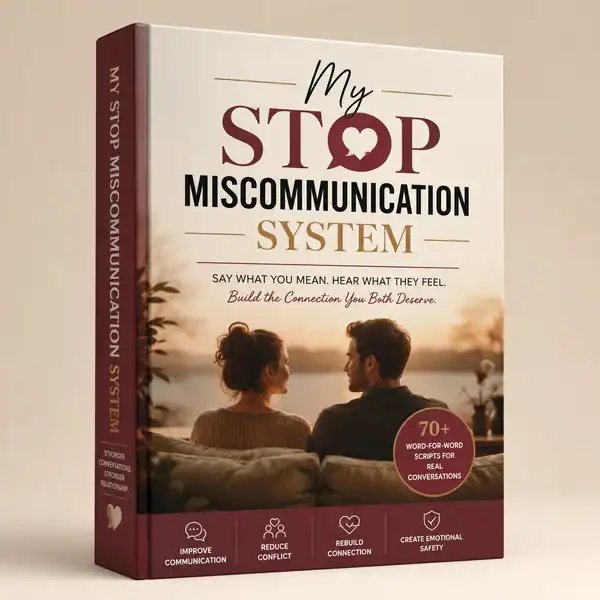
I spent a long time watching couples who loved each other deeply keep getting stuck in the same moments. The same escalation. The same shutdown. The same conversation that never quite got to the real thing.
And I kept thinking — nobody is giving these people the actual language. Not the frameworks. The words. The sentence you say at 9pm when the conversation is going wrong and your brain is flooded and everything you know about communication has temporarily left your body.
That is what the Stop Miscommunication System was built for.
Not to teach you concepts you already know exist. To give you the exact words for the exact moments.
There is a script for when they shut down. There is a script for when you are about to say something you will regret. There is a framework for turning the complaint into the need it is actually expressing. There is a step-by-step blueprint for the conversation you have been avoiding for three weeks.
Six modules. Sixty-plus scripts. The structure that most couples spend years trying to improvise.
It is not a course you sit down and finish. It is something you keep on your phone and reach for when the window is still open.
The only thing left to say.
If you recognise your relationship in any of this — the recurring argument, the conversation that always tips, the feeling of walking away from something unresolved again — I want you to know one thing.
That is not evidence that something is broken between you.
It is evidence that you are both trying without the right tools.
The argument about dishes was never about the dishes. The argument you keep having is not about the thing it appears to be about.
It is about needs that deserve to be named and met.
And you deserve to know how to do that.
The Stop Miscommunication System gives couples the exact words for the moments that keep going wrong. 6 modules, 60+ word-for-word scripts, built for real conversations.