If you have ever felt like you care more, worry more, and need more reassurance than everyone else — this is for you.
I want to start with something that I think most people with an anxious attachment style have never actually heard.
You are not too much.
You are not needy. You are not clingy. You are not broken or dramatic or unreasonable for needing what you need.
You have an anxious attachment style — and that means your nervous system learned, at a very early age, that love was not guaranteed. That the people you depended on were not always there when you needed them. That connection was something you had to work for, monitor constantly, and fight to keep.
That lesson was not your fault. And it did not make you weak.
But it is affecting your relationships right now. And recognising the signs of an anxious attachment style — really recognising them, not just intellectually understanding the concept — is the first step toward something different.
So let’s talk about what it actually looks and feels like to have an anxious attachment style in a relationship. Not the clinical definition. The lived experience.
What Is an Anxious Attachment Style — And Where Does It Come From?
Before we get into the signs, it is worth spending a moment on what anxious attachment actually is — because I think a lot of people who have it do not fully understand where it comes from, and that matters.
Anxious attachment style develops in childhood, almost always in response to caregiving that was inconsistent, unpredictable, or emotionally unavailable. Not necessarily neglectful or abusive — just inconsistent. A parent who was warm and present sometimes and distracted or withdrawn other times. A caregiver whose emotional availability depended on their own stress, mood, or circumstances.
When a child cannot predict whether their caregiver will be available, they learn to adapt. They become hypervigilant to signs of disconnection. They monitor the caregiver’s mood and behaviour constantly, looking for signals of availability or withdrawal. They learn that expressing need loudly and persistently is more likely to get a response than expressing it quietly.
That adaptation — that hypervigilant monitoring system — follows the child into adulthood. Into every close relationship they have. Into their romantic partnership right now.
The anxious attachment style is not a character flaw. It is a survival strategy that was once brilliant and is now causing problems.
The 15 Signs You Have an Anxious Attachment Style
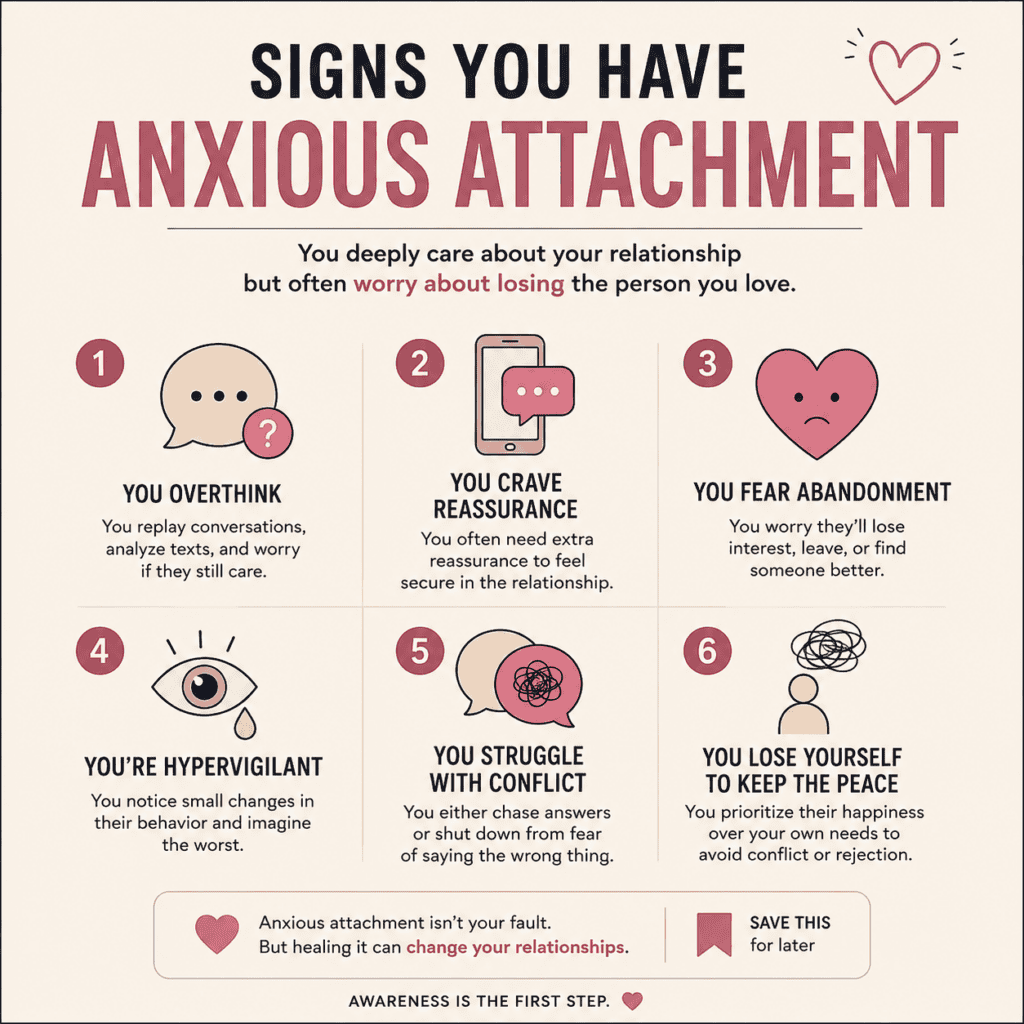
1. You Read Into Everything
A slower text reply. A slightly different tone. A shorter response than usual. A quieter evening. A look across the room that did not feel quite warm.
If you have an anxious attachment style, your nervous system is constantly processing these small signals — not as neutral data, but as potential evidence of something going wrong. You are running a threat detection system that operates below the level of conscious thought, and it is extraordinarily sensitive.
This is not paranoia. This is hypervigilance — and for the anxious attachment style, it is automatic. The monitoring does not turn off when there is nothing to monitor. It just keeps scanning.
Most people around you do not notice what you notice. They do not register the micro-shifts in tone or timing. You notice all of it. And each one produces a small spike of anxiety that demands to be addressed.
2. You Need Reassurance — And Feel Guilty About Needing It
One of the most painful aspects of the anxious attachment style is the reassurance loop.
You feel anxious. Your partner reassures you. You feel better — for a while. Then the anxiety returns. You need reassurance again. Your partner provides it again. But this time it takes a little more. Or lasts a little less long.
Over time, the reassurance provides diminishing returns. And you start to feel guilty — not just for needing it, but for needing it again. For being this person who cannot seem to be settled by the reassurance they asked for.
The guilt is real. The loop is real. And both of them are completely characteristic of the anxious attachment style.
What is actually happening is that you are seeking external regulation for an internal anxiety that has not yet learned to self-soothe. The reassurance treats the symptom — the spike of anxiety — without addressing the underlying pattern. Which is why it has to be repeated.
3. You Feel More Intensely in Relationships Than Most People Seem To
When things are good with your partner, they are really good. You feel full and close and connected in a way that is genuinely beautiful.
When things are even slightly off — a cool interaction, an unresolved tension, a conversation that ended strangely — the drop is enormous. Not proportionate to what actually happened. Enormous.
This emotional intensity is one of the hallmarks of the anxious attachment style. The stakes in romantic relationships feel existentially high. Not because you are dramatic — but because your nervous system learned that love and connection were precarious. That they could be withdrawn. That they required constant vigilance to maintain.
When the thing you are vigilantly protecting feels threatened — even slightly — the alarm is deafening.
4. You Worry About Being Abandoned — Even When There Is No Real Reason To
People with an anxious attachment style carry a specific fear underneath most of their relationship anxiety. It is not always conscious. But it is almost always there.
The fear that they will be left.
Not based on anything their partner has actually done. Not based on evidence of infidelity or disinterest. Based on a deep, old, bone-level belief that love is temporary and that the people they attach to eventually leave.
This fear produces behaviours that can push people away — which then confirms the fear. The anxious attachment style carries the heartbreaking irony of being most afraid of the very outcome its protective behaviours sometimes create.
5. You Are the One Who Usually Brings Things Up
In relationships shaped by anxious attachment style dynamics, there is often a recognisable pattern. One partner is the one who initiates hard conversations, names tensions, pursues resolution. The other tends to be more comfortable letting things sit.
If you consistently find yourself being the one who raises concerns, who checks in on the state of the relationship, who cannot let unresolved things rest — this is likely your anxious attachment style at work.
The discomfort of unresolved tension is significantly higher for people with anxious attachment than for those with avoidant or secure styles. You cannot let it sit. Your nervous system will not allow it. You need resolution the way other people need water — urgently and regularly.
6. You Apologise First — Even When It Was Not Your Fault
This one is painful to recognise. But it is extremely common in people with an anxious attachment style.
The tension of conflict — the distance it creates, the uncertainty about whether the relationship is okay, the fear that the other person might be pulling away — becomes intolerable. And the fastest way to end that tension is to apologise. Even if you do not believe you were wrong. Even if what actually needs to happen is the other person acknowledging their part.
You apologise to restore the connection. To end the uncertainty. To know that things are okay between you.
And every time you do it, something small erodes. Because you have not resolved the conflict — you have just ended the discomfort of it. The unresolved thing stays unresolved, underneath the apology, waiting.
7. You Interpret Your Partner’s Need For Space As Rejection
When your partner needs alone time, wants a quiet evening, asks for space after a difficult conversation — how does that land for you?
For most people with an anxious attachment style, the answer is: badly.
Not because you are unreasonable. But because your nervous system interprets withdrawal as a threat signal. Space does not feel like space. It feels like the beginning of distance. Distance feels like the beginning of loss.
The anxious attachment style often cannot distinguish between a partner who needs to recharge and a partner who is pulling away. Both produce the same alarm. Both trigger the same pursuit.
8. You Replay Conversations Looking For What Went Wrong
After a conversation with your partner — especially one that felt even slightly charged — do you find yourself replaying it?
Looking for the moment things shifted. Analysing what you said and what they said and what they might have meant. Running through alternate versions of what you could have said. Preparing for conversations about the conversation.
This mental replaying is another characteristic sign of the anxious attachment style. The mind is trying to solve a problem — to identify the threat and neutralise it — by processing the same material over and over.
The problem is that this processing rarely produces resolution. It produces more anxiety, because the replaying generates new interpretations and new concerns rather than settling the original ones.
9. You Struggle When Your Partner Is Emotionally Unavailable
Everyone has days when they are depleted. When they come home from a difficult day and do not have much emotional bandwidth. When they are preoccupied with something and cannot be fully present.
For people without anxious attachment, this is understandable. Temporary. Not about them.
For people with anxious attachment style, it is often experienced as emotional withdrawal — as the beginning of a pattern rather than a one-off state. The unavailability feels personal. It triggers the monitoring system. It produces the urge to pursue or fix or resolve.
The awareness that the emotional unavailability is not about you is there intellectually. But the body does not always listen to the intellect.
10. You Feel Like You Love More or Need More Than Your Partner
One of the most isolating beliefs that comes with the anxious attachment style is the sense of asymmetry.
The sense that you feel more. Care more. Need more. That the relationship matters more to you than it does to your partner.
This feeling is almost never accurate. Most partners with avoidant attachment care deeply — they simply express and experience that care differently. But the asymmetry feels real. And it produces a quiet desperation that can drive the pursuit behaviour that then creates actual distance.
11. You Have Stayed In Relationships That Were Not Good For You
People with an anxious attachment style often find it harder to leave relationships — even ones that are clearly not serving them — than people with other attachment styles.
The fear of abandonment works in both directions. It makes the ending of a relationship feel catastrophic, even when the relationship itself is painful. The familiar pain of a difficult relationship is often less threatening than the unfamiliar uncertainty of being alone.
If you look back at your relationship history and recognise a pattern of staying too long — this is often the anxious attachment style at work.
12. You Feel Most Anxious When Things Are Actually Going Well
This one surprises people. But it is real.
For many people with anxious attachment style, periods of genuine happiness and security in a relationship produce their own anxiety. Because things going well means there is something to lose. And the monitoring system that has always been oriented toward threat cannot quite believe that the threat is gone.
Sometimes the anxiety spikes specifically when the relationship feels most stable. Because the nervous system is waiting for the other shoe to drop.
13. You Seek Constant Closeness — And Feel Guilty When It Is Not Available
People with anxious attachment style typically have a higher need for closeness, physical presence, and emotional availability than those with other attachment styles.
This is not a problem in itself. The problem arises when that need cannot be met in a given moment — and the unmet need is experienced not just as disappointing but as threatening. As evidence of something wrong.
And then there is the guilt. The sense that wanting so much closeness is a burden. That needing your partner the way you need them is too much. That you should be able to manage better than this.
The guilt about the need is almost as painful as the unmet need itself.
14. You Have Trouble Trusting — Even When Your Partner Has Given You No Reason Not To
Trust is genuinely difficult for the anxious attachment style — not because of anything a partner has specifically done, but because the nervous system was calibrated in an environment where trust was regularly disrupted.
You may trust your partner consciously. You may know, intellectually, that they are reliable and honest and committed. But somewhere underneath that knowing, the anxiety persists. Because the anxious attachment style has a body memory of trust being broken that intellectual reassurance cannot fully override.
15. You Long For A Relationship That Feels Safe — And Don’t Quite Believe It Is Possible
This might be the deepest sign of the anxious attachment style. The longing.
The longing for a relationship that feels genuinely secure. Where you do not have to monitor. Where you can trust that love is not conditional. Where you can express a need without fear that it will push someone away.
You long for that. And somewhere underneath the longing is the fear that it is not possible for you. That other people get that kind of love but you — with all your anxiety, all your needs, all your monitoring — are not someone who gets to have it.
That fear is the wound underneath the anxious attachment style. And it is the thing that, when it is addressed with the right tools and the right support, can actually begin to heal.
Read more How to Deal With a Partner Who Has No Emotional Intelligence
Why Does Every Conversation Turn Into an Argument?
What to Say When Your Partner Shuts Down During a Conversation
15 Phrases That Stop Arguments Before They Get Worse
What Anxious Attachment Style Does to Your Relationship
Understanding the signs of an anxious attachment style is one thing. Understanding how those signs affect the relationship dynamic is another — and it is essential, because anxious attachment does not operate in isolation. It operates in relationship with another person’s nervous system.
The most common dynamic is the anxious-avoidant pairing. One partner — the anxiously attached one — pursues. They bring things up, seek reassurance, reach for closeness when they feel tension. The other partner — the avoidantly attached one — withdraws. They need space, feel overwhelmed by emotional intensity, and go quiet when things get heated.
The pursuit triggers the withdrawal. The withdrawal triggers the pursuit. The cycle feeds itself.
Neither person is doing this on purpose. Both are responding authentically to what their nervous system is telling them to do. But the result is a relationship pattern that feels increasingly impossible — where both people feel increasingly unseen.
The other common dynamic is the anxious partner in a relationship with a secure partner. Here the situation is different — the secure partner can usually provide the reassurance and stability the anxious partner needs. But the anxious partner often cannot trust it. Cannot let it land. Because their nervous system is so calibrated to watch for withdrawal that genuine security produces its own anxiety.
Can You Change an Anxious Attachment Style?
This is the question I get asked most often. And my honest answer is yes — but with important nuance.
The anxious attachment style does not disappear. The nervous system that developed it is the same nervous system you have now. The hypervigilance, the monitoring, the sensitivity to disconnection — these are deep patterns.
But they can become less automatic. Less controlling. Less likely to drive behaviour that damages the connection you are trying to protect.
What changes the anxious attachment style is not willpower or intellectual understanding. It is new experience — consistently, repeatedly encountering a different relational reality than the one the nervous system was calibrated for. A partner who comes back. A need that is met without punishment. A moment of vulnerability that is received without withdrawal.
And alongside that new relational experience — the right tools. The specific language for the moments the anxious attachment style takes over. The framework for asking for what you need without the guilt or the loop. The practice for catching the anxiety spiral before it drives the pursuit behaviour.
The Tools That Actually Help
Most advice for anxious attachment style tells you to self-regulate. To breathe. To trust more. To need less.
That advice is not wrong. But it is not specific enough to be useful in the moment when the anxiety is at its peak and your nervous system has taken the wheel.
What actually helps is having the exact words for the exact moment.
The sentence to say when you need reassurance but feel guilty asking.
The script for when your partner goes quiet and you feel the panic rising.
The framework for expressing what you actually need — rather than the complaint that comes out of fear.
The daily practice that builds internal regulation over 30 days so that the external reassurance-seeking becomes less necessary.
That is exactly what the Anxious Partner Communication System was built to give you. Not concepts. Not general advice about attachment theory. The actual language — for the actual moments — when the anxious attachment style takes over and you do not know what to say.
Five focused guides. Twenty word-for-word scripts. The Reassurance Request Framework. The Spiral Interruption Method. A 30-day nervous system regulation practice.
Everything built specifically for the anxious attachment style — for what it actually feels like from the inside.
You Are Not Too Much
I want to come back to where we started. Because I think it bears repeating.
The signs of an anxious attachment style that we have covered in this article — the monitoring, the reassurance loop, the pursuit, the fear of abandonment, the guilt about your own needs — these are not evidence that you are fundamentally flawed as a partner.
They are evidence that you are someone whose nervous system learned a specific lesson about love — and that lesson is now creating problems in your relationship.
Lessons can be unlearned. Patterns can be interrupted. Nervous systems can learn new things.
Not overnight. Not through simply deciding to be different. But through the right tools, the right language, and enough consistent new experience to teach your body something different from what it has always known.
You deserve a relationship that feels safe. Not as a distant possibility. As something you are actively building toward — starting with understanding exactly what your anxious attachment style is doing, why it is doing it, and what to say instead.
The Anxious Partner Communication System gives you the exact scripts, frameworks, and 30-day practice for the anxious attachment style — everything built for the real moments, not the calm version of them. Available at now check here.