You want them close. The second they actually get close, something in you wants to run. You crave reassurance, and when it’s offered, you don’t quite trust it. You’ve pushed someone away and ached for them in the same breath. If that push-pull has ever left you wondering what’s wrong with you, here’s the more accurate question: what happened to you, and what did your nervous system learn to do about it.
This is disorganized attachment style — sometimes called fearful-avoidant attachment — and it’s the least talked-about, most misunderstood of the four attachment styles. Anxious attachment gets its own genre of relationship content. Avoidant attachment has become a meme. Disorganized attachment barely gets a paragraph, even though it’s often the most painful pattern to live inside, because it isn’t one contradiction, it’s two running at once.
This guide covers what disorganized attachment style actually is, where it comes from, how it shows up day to day, what current research says about it, and — the part almost no other article gives you — practical, real-time tools for the exact moment you feel pulled in two directions. If you want a quick, structured starting point before reading further, our free attachment style quiz takes about two minutes and can help you see where your own patterns land.
What Is Disorganized Attachment Style, Exactly
Disorganized attachment style is a relationship pattern where closeness is both deeply wanted and genuinely frightening at the same time. Unlike anxious attachment (which mainly pursues connection) or avoidant attachment (which mainly protects independence), disorganized attachment does both — often within the same conversation, sometimes within the same sentence.
Researchers also refer to this as fearful-avoidant attachment, because it combines features of both other insecure styles: the anxious fear of abandonment and the avoidant fear of engulfment, operating simultaneously rather than as two separate phases. The result is a nervous system that never fully settles into one strategy, because neither pursuing nor withdrawing ever feels completely safe.
This isn’t a personality flaw, a diagnosis, or a permanent life sentence. It’s an adaptive response your nervous system built, usually very early in life, to a specific problem: what do you do when the person you need for safety is also, at times, a source of fear or unpredictability. The answer your body found was to hold both responses ready at once — which made sense as a survival strategy, and which can feel exhausting and confusing to live with as an adult.
Where Disorganized Attachment Style Actually Comes From
Attachment theory, developed by John Bowlby and expanded through Mary Ainsworth’s research, describes how infants build strategies for handling connection and separation based on how consistently a caregiver responds to them. Disorganized attachment is the pattern researchers identified in children whose caregiver was, at different times, both their source of comfort and their source of fear.
This can develop from a range of experiences, including:
- Caregiving that alternated between affection and frightening, unpredictable, or frightened behavior
- Early experiences of abuse, neglect, or chronic instability in the home
- A caregiver who was themselves unresolved around their own trauma or loss, creating an inconsistent emotional environment
- Household chaos, addiction, or mental health crises that made a child’s environment feel unsafe in ways that were hard to predict
- Repeated experiences of a caregiver being simultaneously needed and unavailable or frightening
It’s worth being clear about something here: disorganized attachment style doesn’t require severe childhood trauma to develop, though it’s more strongly associated with it than the other insecure styles. Subtler forms of relational unpredictability — a household where love felt conditional and occasionally frightening, without necessarily involving overt abuse — can also contribute. What matters most isn’t the specific event, but the child’s takeaway: that the people closest to me can also be the reason I don’t feel safe.
Common Signs of Disorganized Attachment Style
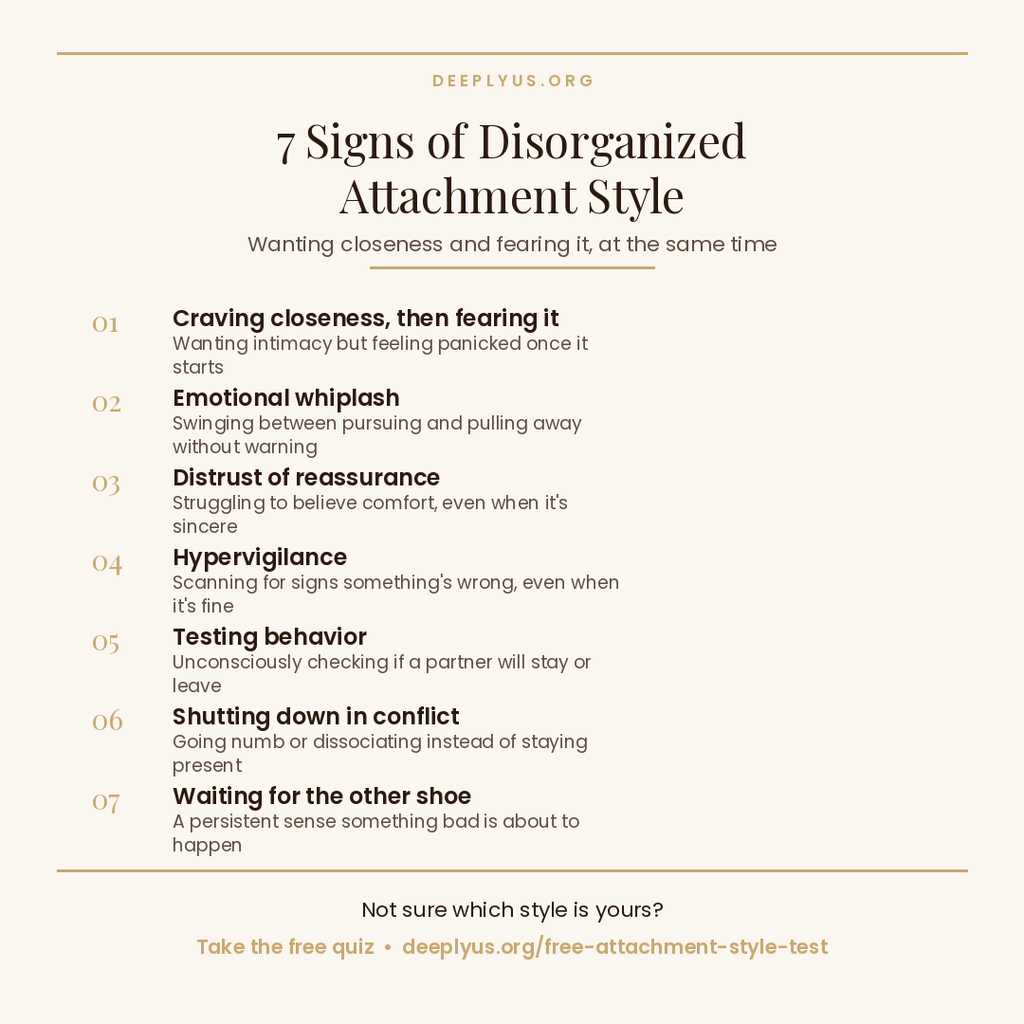
Disorganized attachment style shows up as a set of contradictions rather than a single consistent pattern, which is part of what makes it so disorienting to live with and so easy for others to misread. Common signs include:
- Craving deep closeness, then feeling panicked, numb, or overwhelmed once it starts to happen
- Emotional whiplash in relationships — swinging between pursuing a partner intensely and pulling away without warning
- Difficulty trusting reassurance, even when it’s offered consistently and sincerely
- Hypervigilance for signs that something is wrong, even in relationships that are objectively stable
- Trouble identifying or naming your own needs, sometimes not realizing what you need until well after the moment has passed
- A pattern of testing a partner’s commitment, sometimes unconsciously, to see if they’ll stay
- Dissociating, shutting down, or going emotionally blank during conflict rather than staying present
- Alternating between oversharing vulnerable feelings and withdrawing sharply afterward
- A persistent sense of waiting for something to go wrong, even during genuinely good periods
- Difficulty holding a consistent, stable image of a partner — shifting quickly between idealizing them and feeling threatened by them
If several of these feel familiar, that’s useful information about a pattern, not evidence that something is fundamentally wrong with you. Disorganized attachment style exists on a spectrum, and most people recognize themselves in some, not all, of these experiences.

The Real Experience: What Disorganized Attachment Actually Feels Like
This is the part clinical overviews tend to skip, and it’s often the most validating part to actually read.
Disorganized attachment style isn’t just a behavior pattern — it’s two nervous system responses firing at once. The part of you that wants closeness is genuinely activated, reaching for connection. At nearly the same moment, the part of you that learned closeness can be dangerous is also activated, bracing for threat. Neither signal fully overrides the other, so the result often feels like being pulled in opposite directions by your own body, with no clear “right” response available.
This is why disorganized attachment can feel so different from anxious or avoidant attachment to experience from the inside. Anxious attachment has a clear direction — move toward. Avoidant attachment has a clear direction — move away. Disorganized attachment often has no clear direction at all in the moment, which is part of why it can feel so destabilizing, and why “just pick a response and stick with it” rarely works as advice. The nervous system isn’t confused about what it wants; it’s holding two true, conflicting needs simultaneously.

What the Research Actually Says
Disorganized attachment has a substantial body of research behind it, more directly tied to trauma and mental health research than the other insecure styles. Studies consistently link disorganized attachment with higher rates of anxiety, depression, and difficulty with emotional regulation. Some research also notes overlapping features between disorganized attachment and certain personality disorders, particularly borderline personality disorder, in areas like fear of abandonment, relationship instability, and emotional intensity.
It’s genuinely important to be precise here: having a disorganized attachment style does not mean someone has, or will develop, a personality disorder, and the two are not interchangeable. Overlap in some features is not the same as equivalence, and only a qualified mental health professional can make an actual clinical diagnosis. What the research does support clearly is that disorganized attachment tends to respond well to structured, relationship-focused therapeutic approaches — including trauma-informed therapies like EMDR, along with CBT and DBT-based emotional regulation work — and that meaningful change, often called earned secure attachment, is well documented as achievable with sustained support.
Disorganized Attachment Style in Romantic Relationships
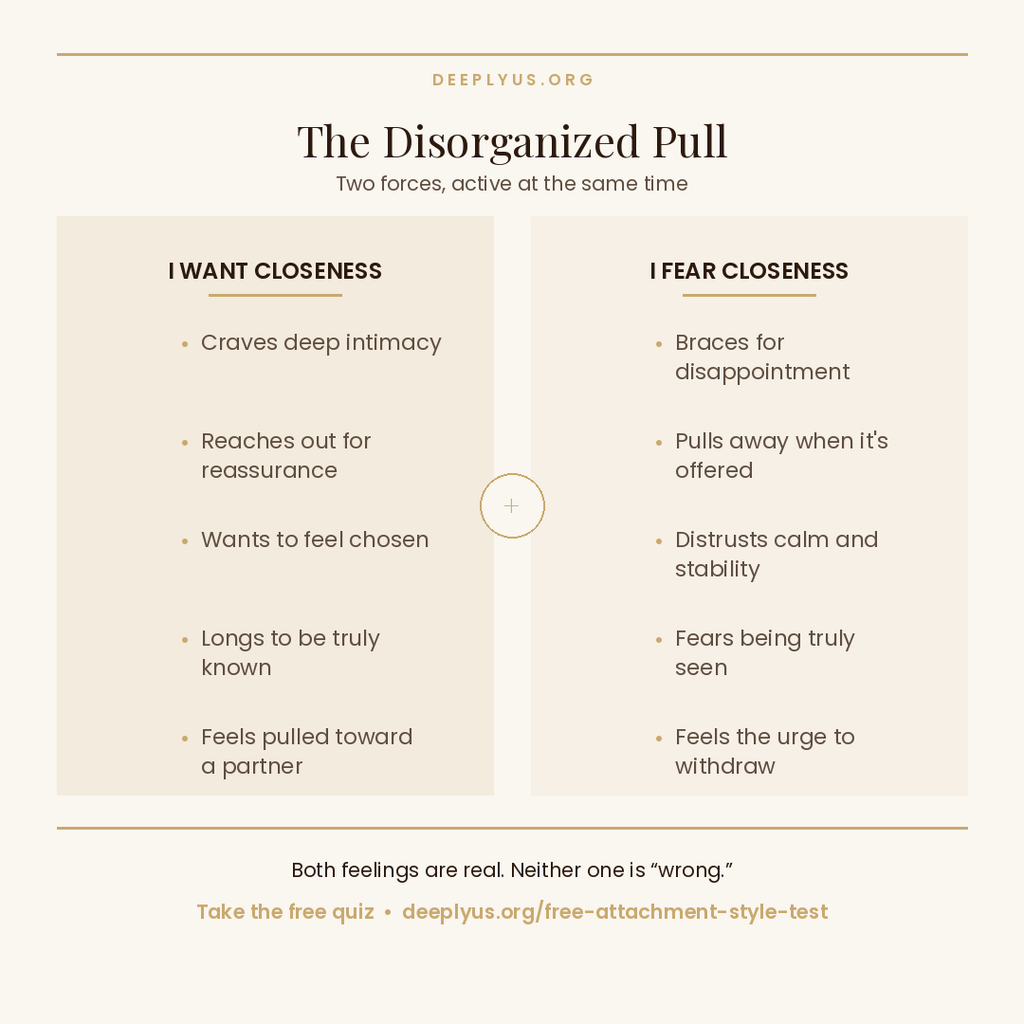
This is where the pattern tends to feel most intense, because romantic relationships involve exactly the kind of sustained closeness that activates both halves of the disorganized response.
In practice, this often creates a specific, exhausting cycle. A relationship starts to deepen — more time together, more vulnerability, more reliance on each other. Instead of feeling steadily more secure, the disorganized partner may feel an escalating sense of alarm underneath the closeness, even if nothing has gone wrong. That alarm can express itself in contradictory ways: pulling away suddenly, picking a fight seemingly out of nowhere, testing whether the partner will leave, or oscillating between intense affection and cold distance within the same week.
Here’s what that can sound like without an understanding of the pattern:
Partner: “Things have felt really good between us lately. I feel closer to you.”
Disorganized partner (feeling a spike of fear beneath the closeness): “Yeah… I don’t know, maybe we’ve just been distracted. I feel like something’s off, actually.”
Partner (confused): “Off how? I thought we were doing well.”
Disorganized partner: “I don’t know. Forget it.” [Withdraws for several days, then reaches out anxiously wondering if the relationship is at risk.]
Neither person is being manipulative here. The disorganized partner’s alarm system is responding to genuine internal fear, not to anything their partner actually did — but without a name for what’s happening, both people are left confused, and the pattern tends to repeat.
This dynamic often overlaps meaningfully with anxious-avoidant relationship patterns, since disorganized attachment essentially holds both of those responses inside one person. Many of the same repair tools that help anxious-avoidant couples — clear language for needs, predictable reassurance, learning to self-soothe before reacting — also help here, though disorganized attachment usually benefits from a slower, more trauma-aware version of that work. This is exactly the kind of recurring, confusing conflict our Stop Miscommunication System was built to help couples navigate, with structured, word-for-word tools for the moments when a conversation suddenly goes sideways for reasons neither partner can quite explain.
Disorganized Attachment Beyond Romance: Friendships, Family, and Self-Trust
Most content on this topic focuses only on romantic relationships, but disorganized attachment style shapes far more than dating life. It commonly shows up in:
- Friendships: pulling close to a friend quickly, then feeling suddenly wary of their intentions; difficulty trusting long-standing friendships even when there’s no real reason for doubt
- Family relationships: an ongoing push-pull with the very caregivers who shaped the pattern, sometimes craving their approval and resenting the need for it in the same conversation
- Self-trust: difficulty trusting your own read of a relationship, since your internal signals about safety and threat can feel contradictory or unreliable in the moment
- Work relationships: difficulty trusting positive feedback from a manager, or oscillating between over-investing in a professional relationship and abruptly disengaging from it
Recognizing this broader pattern matters because it reframes disorganized attachment as a nervous system tendency that follows you across contexts — which also means healing it strengthens far more than just your romantic relationships.
Disorganized vs Anxious vs Avoidant vs Secure: A Quick Comparison
| Disorganized | Anxious | Avoidant | Secure | |
|---|---|---|---|---|
| Core fear | Both abandonment and engulfment, at once | Abandonment | Engulfment | Neither dominates |
| Under stress | Oscillates unpredictably between pursuing and withdrawing | Pursues, seeks reassurance | Withdraws, needs space | Communicates directly |
| View of self | Fragmented, hard to pin down | “I’m not enough” | “I don’t need anyone” | “I’m worthy of love” |
| View of others | Both needed and unsafe | “They might leave” | “They want too much” | Generally trustworthy |
| Common origin | Frightening or unpredictable caregiving | Inconsistent caregiving | Emotionally unavailable caregiving | Consistent, attuned caregiving |
| Healing direction | Building internal safety and consistent regulation, often with trauma-informed support | Building self-soothing and secure independence | Learning to stay present and express need | Maintaining existing patterns |
Seeing disorganized attachment style laid out next to the other three makes something important visible: it isn’t simply “worse anxious attachment” or “worse avoidant attachment.” It’s a genuinely distinct pattern, because it holds both fears active at once instead of leaning primarily toward one.
How to Work With the Pattern in Real Time
Understanding disorganized attachment style intellectually is step one. Building the capacity to notice and gently interrupt it in the moment is the harder, more useful skill — and while it takes longer to build than with anxious or avoidant attachment alone, it is genuinely learnable.
In the moment
- Name both parts, out loud if you can. “Part of me wants to get closer right now, and part of me is scared” is more accurate — and more manageable — than picking one feeling and acting only on that.
- Slow down before reacting. Disorganized responses often move fast. A few slow, extended exhales create just enough space to notice the urge to withdraw or escalate before acting on it.
- Ground in the present moment. Naming five things you can see or feel in the room can help interrupt the pull into an old fear response that belongs to a different time in your life.
- Avoid making a big decision mid-spike. If you feel the urge to end things, push someone away, or demand certainty right now, it’s usually worth waiting until the intensity passes before acting.
Within the day
- Track which part activated, and what triggered it. Was it closeness, conflict, a compliment, a request for more commitment? Disorganized responses often have identifiable triggers once you start watching for them.
- Practice naming needs even when it feels unfamiliar. “I think I need reassurance, but I also feel like pulling away right now” is a genuinely useful sentence to say to a trusted partner or friend.
- Repair after a withdrawal or a testing behavior, even briefly. “I pulled away earlier because I got scared, not because of anything you did” helps rebuild trust in the relationship and in your own capacity to come back.
As an ongoing practice
- Build consistency with yourself first. Small, repeated acts of self-trust — keeping commitments to yourself, noticing your own needs before they become overwhelming — lay groundwork for trusting consistency from others.
- Seek relationships and support that offer steadiness. Predictable, patient responses from a partner, friend, or therapist are one of the most effective correctives to a nervous system that learned closeness was unpredictable.
- Consider trauma-informed therapeutic support. Because disorganized attachment is more closely tied to early relational trauma than the other insecure styles, professional support — particularly approaches like EMDR, attachment-based therapy, or DBT skills work — often accelerates healing significantly compared to self-guided work alone.
What Helps If Your Partner Has a Disorganized Attachment Style
If you love someone with disorganized attachment style, a few specific approaches tend to help far more than generic reassurance:
- Stay consistent, especially during conflict. Predictability over time is what slowly teaches a disorganized nervous system that closeness doesn’t have to be followed by danger.
- Don’t take withdrawal personally, but don’t ignore it either. A brief, low-pressure check-in — “I noticed you pulled back, no pressure to talk right now, just want you to know I’m here” — tends to land better than either chasing or matching the distance.
- Validate without trying to immediately fix. “It makes sense that closeness feels scary sometimes, given what you’ve been through” can be more grounding than reassurance alone.
- Hold boundaries with compassion. Consistency includes not abandoning your own needs — a relationship that only accommodates the disorganized partner’s fear responses without any structure tends to reinforce instability rather than heal it.
Can Someone With Disorganized Attachment Style Build a Secure Relationship
Yes — and this deserves real emphasis, because a lot of content on this topic leans heavily into the difficulty of disorganized attachment without landing clearly on this point: earned secure attachment is well documented, even for the most complex of the insecure styles.
The path typically involves:
- Building internal emotional regulation skills before expecting external relationships to feel fully safe
- Practicing naming both halves of the pull toward and away from closeness, rather than acting on only one
- Seeking relationships — romantic, platonic, or therapeutic — that offer sustained, patient consistency
- Where relevant, working with a trauma-informed therapist to address the deeper roots of the pattern, since disorganized attachment often benefits from more structured support than self-help alone can provide
Alongside professional support, many people find it helpful to have practical, everyday tools for the relationship patterns disorganized attachment often intersects with — particularly the anxious-avoidant push-pull dynamic. Our Stop Miscommunication System was built specifically for couples caught in these recurring, confusing cycles, and our Anxious Attachment Toolkit offers real-time tools for the anxious half of the disorganized pull that many people find useful alongside deeper therapeutic work. For couples working on rebuilding a sense of safety and predictability together, our Date Night Cards — 52 Conversation Prompts for Couples provide one guided, low-pressure conversation a week, which can help build the kind of gentle, consistent connection that supports healing over time.
When to Seek Professional Support
Given how closely disorganized attachment style is tied to early relational experiences, professional support is worth strongly considering — not as a last resort, but as a genuinely effective and often necessary part of the healing process. Consider reaching out to a therapist, ideally one trained in trauma-informed or attachment-based approaches, if:
- The push-pull pattern is significantly affecting your relationships, work, or daily functioning
- You notice intense emotional swings, dissociation, or shutting down during conflict
- Your history includes childhood trauma, abuse, or chronic instability that feels connected to your current patterns
- You’ve tried self-guided tools and feel like you need more structured, sustained support to make progress
Reaching out for support here isn’t a sign that you’ve failed at healing on your own — disorganized attachment is one of the patterns where professional guidance most reliably speeds and deepens the work.
Frequently Asked Questions About Disorganized Attachment Style
What is the main cause of disorganized attachment style? It typically develops from caregiving that was, at different times, both a source of comfort and a source of fear or unpredictability — often linked to childhood trauma, chronic instability, or a caregiver’s own unresolved distress, though it doesn’t always require severe trauma to develop.
Is disorganized attachment the same as fearful-avoidant attachment? Yes, these terms describe the same underlying pattern. “Disorganized” is more common in academic and childhood-development research, while “fearful-avoidant” is often used to describe how the pattern shows up in adult relationships.
Is disorganized attachment the same as borderline personality disorder? No. There is documented overlap in some features, such as fear of abandonment and emotional intensity, but disorganized attachment is not a personality disorder, and having one does not mean a person has or will develop the other. Only a qualified mental health professional can make a clinical diagnosis.
Can disorganized attachment style be healed? Yes. Research supports the concept of earned secure attachment, achieved through consistent self-awareness, nervous system regulation, and — for most people with this style — sustained support from a trauma-informed therapist alongside patient, consistent relationships.
How is disorganized attachment different from anxious or avoidant attachment? Anxious attachment mainly moves toward connection under stress, and avoidant attachment mainly moves away. Disorganized attachment holds both responses active at once, which is why it can feel less predictable and more internally conflicting than either style alone.
What triggers a disorganized attachment response? Common triggers include increasing closeness or vulnerability in a relationship, conflict, feeling criticized, or situations that echo earlier experiences of unpredictability — though triggers vary significantly from person to person.
Can two people with insecure attachment styles build a healthy relationship together? Yes, though it usually requires more intentional work. Understanding each partner’s specific pattern — including if one or both partners lean toward disorganized attachment — makes it significantly easier to respond to conflict with curiosity instead of confusion or blame.
Should I go to therapy for disorganized attachment style, or can I heal on my own? Self-guided tools like the ones in this guide can genuinely help, but because disorganized attachment is more closely tied to early trauma than the other insecure styles, most people benefit significantly from working with a trauma-informed therapist alongside that self-guided work.
The Bottom Line
Disorganized attachment style isn’t a character flaw, and it isn’t a fixed diagnosis you’re stuck with. It’s a nervous system that learned, early and often under real duress, to hold two contradictory truths at once: I need this closeness, and this closeness might not be safe. That strategy made sense given what it was responding to. It doesn’t have to define every relationship you have from here forward.
Healing this pattern tends to be slower and deeper than healing anxious or avoidant attachment alone, and that’s not a discouraging fact — it’s simply an honest one. With consistent support, whether that’s trauma-informed therapy, patient and predictable relationships, or both, earned secure attachment is a well-documented, genuinely achievable outcome.
If you’re ready to understand your own pattern more clearly, start with our free attachment style quiz, and explore the tools inside our Stop Miscommunication System for practical support alongside whatever deeper healing work you choose to pursue. You didn’t choose this pattern. But with the right support, you get to slowly, steadily choose something different.