Okay so here is a question I want you to sit with for a second.
When your partner goes quiet after an argument — are they giving you the silent treatment, or do they genuinely need space to regulate?
Because here is the thing. These two situations look almost identical from the outside. Both involve withdrawal. Both involve silence. Both involve one person becoming suddenly unavailable in a way that the other person finds deeply uncomfortable.
But they are completely different things. With completely different causes. And they require completely different responses.
Getting them confused — which most couples do, most of the time — is one of the most damaging mistakes you can make in a relationship. Because if your partner genuinely needs space and you pursue them, you make it worse. And if your partner is giving you the silent treatment and you back off and give them space, you reward the behaviour and it escalates.
The silent treatment and the need for space look the same on the surface. But underneath, they are worlds apart.
This article is going to give you the clearest, most practical guide to telling them apart — and what to do once you know which one you are dealing with.
Why This Question Matters More Than You Think
I talk to couples every week who are stuck in a specific kind of confusion about this.
One person says: “When I go quiet, I genuinely need time to process. I’m not punishing them. I just can’t talk when I’m overwhelmed.”
The other person says: “It doesn’t feel like they need space. It feels like punishment. It feels deliberate. It feels like they’re taking something away from me to make a point.”
Both of them are sincere. Both of them believe they are right. And both of them are partially correct — because the silent treatment and genuine space needs exist on a spectrum, and a lot of relationships exist somewhere in the complicated middle of that spectrum.
But the distinction is not impossible to make. And making it correctly changes everything about how you navigate conflict.
What the Silent Treatment Actually Is
Let me be specific here, because the phrase “silent treatment” gets used loosely.
The silent treatment is the deliberate withdrawal of communication as a form of punishment, control, or emotional leverage.
The key word is deliberate. The person giving the silent treatment is making a choice — consciously or unconsciously — to use their silence as a message. The silence itself is the communication. It is saying: you hurt me and I am going to make you feel that by making myself unavailable.
The silent treatment has a purpose. It is designed to produce a specific effect in the other person — anxiety, guilt, the desperate urge to repair the situation on the silent person’s terms.
It is, to be direct about it, a form of emotional manipulation. Not always a conscious one. Some people give the silent treatment without ever realising that is what they are doing. They experienced it as children and absorbed it as a normal conflict response. They genuinely believe they are “just not ready to talk” when in reality they are withholding communication as a way of expressing anger they cannot or will not name directly.
The silent treatment is not the same as being upset and struggling to talk. It is strategic silence. It is silence with a target.
What Genuinely Needing Space Actually Is
Now let me be equally specific about the other side.
Genuinely needing space is a neurological reality. When a person becomes emotionally overwhelmed during conflict — when their heart rate spikes, their thinking becomes less clear, and their nervous system registers a threat — they literally lose access to the cognitive functions required for productive communication.
Researchers call this emotional flooding. And during flooding, the brain’s prefrontal cortex — the part responsible for nuanced thought, empathy, and choosing words carefully — goes partially offline. The person is not being difficult. They are physiologically incapable of the conversation in that moment.
Needing space is what happens when a flooded nervous system tries to protect itself. It is a regulation need — not a punishment strategy.
The person who genuinely needs space is not trying to make their partner feel bad. They are trying to get themselves back to a state where they can engage productively. The withdrawal is about their internal state — not a message directed at the other person.
This distinction — internal versus external, regulation versus punishment — is the core of the difference between the silent treatment and needing space.
The 8 Key Differences: Silent Treatment vs Needing Space
This is the section most people need. Let me go through each difference clearly, because once you see them, you cannot unsee them.
1. Communication Versus Silence
Needing space: The person who genuinely needs space will typically say something before going quiet. Not always much — but something. “I need some time.” “I can’t talk right now, I’m overwhelmed.” “Give me 20 minutes.” They communicate the need for space even if they cannot communicate anything else.
Silent treatment: The person giving the silent treatment withdraws without explanation. The silence itself is the statement. There is no “I need time” — there is just the sudden, pointed absence.
This is one of the clearest early indicators. Did they say anything about needing space, or did they just disappear? The communication of the need is almost always present when the need is genuine. The silent treatment rarely announces itself.
2. Return Time
Needing space: Genuine space needs are time-limited. The person who needs space to regulate will usually return — to the conversation, to emotional availability, to connection — within a predictable window. 20 minutes. An hour. An evening. They come back.
Silent treatment: The silent treatment does not have a natural return time. It ends when the person giving it decides the other person has suffered enough, apologised sufficiently, or conceded whatever the silent treatment was designed to extract. The duration is tied to the other person’s behaviour — not to the internal regulation of the person giving it.
Ask yourself: has your partner indicated when they will be ready to engage again? Or is the timeline undefined and seemingly tied to what you do next?
3. What They Respond To
Needing space: A partner who genuinely needs space will be receptive to a calm, low-pressure check-in after a reasonable amount of time has passed. They are not managing their distance in response to your behaviour. They are managing their internal state. So when their nervous system has regulated, they become accessible — regardless of what you did or did not do in the interim.
Silent treatment: A partner giving the silent treatment is acutely aware of what you are doing during the silence. They are monitoring your behaviour. They may soften when you apologise, concede, or show sufficient distress. They may extend the silence if they feel you are not demonstrating enough remorse. Their unavailability is responsive to you — which means it is being managed in relation to you.
This is a significant tell. If your partner’s silence seems to shift based on how you behave during it — if it gets longer when you seem unbothered and shorter when you pursue — that responsiveness suggests silent treatment rather than genuine space.
4. The Underlying Emotion
Needing space: The dominant emotion underneath genuine space needs is overwhelm. The person feels flooded, overstimulated, or incapable of processing any more input. The withdrawal is from sensation, not from the person.
Silent treatment: The dominant emotion underneath the silent treatment is most often anger. Hurt that has not been expressed directly. A sense of injustice or grievance that is being communicated through absence rather than words. Sometimes it is also fear — fear of the conversation, fear of what might be said if they open their mouth — but the silence is still directed at the other person in a way that genuine overwhelm is not.
5. Their Demeanour During the Withdrawal
Needing space: A partner who genuinely needs space is often visibly distressed or depleted during the withdrawal. They may seem flat, exhausted, or checked out. They are not performing the silence — they are experiencing it. They may be quiet but not deliberately cold. They may avoid you without being pointed about it.
Silent treatment: The silent treatment often has a particular quality to it. It can be pointed. Deliberate. Almost theatrical in its conspicuousness. The person giving the silent treatment may make their silence very visible — sitting in the same room but refusing to make eye contact, responding to practical questions with monosyllables, being performatively unavailable. There is an audience quality to it. They are making sure you know you are being ignored.
6. Whether They Can Discuss Basic Needs
Needing space: A partner who genuinely needs space can usually still manage basic, practical communication even during the withdrawal period. “I’m going to bed.” “The kids need picking up at 3.” “There’s food in the fridge.” The shutdown is emotional and conversational — not total.
Silent treatment: The silent treatment often extends to all communication — including basic, practical exchanges. The partner may refuse to answer simple questions, respond to logistics, or acknowledge the other person in any normal way. The comprehensive withholding of communication — across all categories — is characteristic of the silent treatment.
7. How Long It Has Been Going On
Needing space: Genuine regulation needs are relatively short-lived. Most nervous systems can return to an accessible state within 20 to 60 minutes if given appropriate conditions. A few hours is understandable in particularly intense situations. An evening is on the longer end but still within the range of genuine regulation.
Silent treatment: The silent treatment can last days. Sometimes weeks. Sometimes longer. The extended duration is one of the clearest indicators that what is happening is not a nervous system trying to regulate — it is a person using silence as a sustained communication strategy.
If the silence has gone on for more than 24 hours without any communication whatsoever, you are almost certainly dealing with the silent treatment rather than a genuine space need.
8. What Happens When the Silence Breaks
Needing space: When a partner who genuinely needed space returns, they are usually ready and willing to re-engage with the conversation that caused the withdrawal. They come back to the issue. They take responsibility for the space they needed. They often say something that acknowledges the other person’s experience during the wait.
Silent treatment: When the silent treatment ends, it often ends without acknowledgement of the silence itself. The person may simply resume normal behaviour as if nothing happened — or they may use the resumption of communication as an opportunity to extract something (an apology, a concession, a reversal of position) without naming what they were doing during the silence.
The Grey Area — When It Is Both
I want to be honest about something that most articles on this topic are not honest about.
Many people — particularly those with avoidant attachment patterns — do not fit neatly into either category. Their withdrawal starts as a genuine need for space and regulation. But it can tip into something closer to the silent treatment if the regulation takes a long time, if the other partner pursues during the space, or if the withdrawn partner starts to use the duration of the silence as leverage without consciously deciding to do so.
The silent treatment and genuine space needs are not always discrete categories. They can blur, particularly in the middle of a conflict pattern that both people have been stuck in for a long time.
This is important because it means the question is not always “which one is this” but sometimes “which one is this becoming.”
A withdrawal that began as genuine regulation can harden into the silent treatment if it goes on long enough without communication. And a silence that began as the silent treatment can sometimes become genuine overwhelm if the person giving it gets caught up in emotions they cannot access or express.
Neither of these grey areas excuses the behaviour. But they do complicate the clean binary that most articles present.
What the Silent Treatment Does to a Relationship
I want to spend some time here because I think the impact of the silent treatment gets underestimated.
The silent treatment is genuinely harmful in relationships — and not just in the moment it is happening.
On the person receiving the silent treatment:
The silent treatment is one of the most activating experiences in a relationship. For anyone with anxious attachment, it is practically unbearable — because it triggers the exact fear of abandonment and withdrawal that drives anxious attachment in the first place. The person being given the silent treatment often describes it as feeling erased. Like they do not exist. Like the relationship has been suspended without their agreement.
The anxiety produced by the silent treatment often drives the pursuing behaviour that the person giving the silent treatment then uses to justify the silence. It becomes a self-reinforcing cycle.
Over time, repeated experiences of the silent treatment teach the receiving partner that conflict means disappearance. They begin to manage their own behaviour to avoid triggering the silence — walking on eggshells, suppressing concerns, refusing to raise things that need to be raised. The relationship slowly becomes one where one person manages the other’s emotional temperature at the expense of their own needs.
On the relationship itself:
Trust erodes slowly with repeated silent treatment. Not dramatically. Not all at once. But each episode leaves a small residue — a learned understanding that conflict means one person disappears, that repair requires the other person to submit, that safety in this relationship is conditional.
That residue accumulates. And after years, it becomes the ambient temperature of the relationship — a low-grade guardedness that both people feel but neither can quite name.
What Genuinely Needing Space Does to a Relationship — When It Is Not Handled Well
Here is the other side of this, because I want to be fair.
Genuine space needs that are not communicated well create their own damage — even when the intention behind them is not manipulative.
If you regularly go quiet during conflict without explaining why, without giving a return time, without communicating that you will come back — your partner cannot know the difference between the silent treatment and a genuine regulation need. They will experience the withdrawal as the silent treatment regardless of your intention.
Impact is not determined by intention. A genuine space need that is handled as a disappearance lands the same way the silent treatment does.
This is why how you take space matters as much as why you are taking it. A flooded nervous system that says nothing and vanishes is causing harm — even if the intention behind the vanishing is entirely about self-regulation.
The person who genuinely needs space owes their partner, at minimum, two things: a brief communication that they need time, and a return time. “I’m overwhelmed. I need 30 minutes. I’ll be back.” That sentence is not much. But it transforms a potentially traumatising disappearance into a manageable pause.
How to Respond to the Silent Treatment
Knowing you are dealing with the silent treatment rather than a genuine space need changes how you should respond. Here is what actually works — and what makes it worse.
What makes the silent treatment worse:
Pursuing relentlessly. Sending multiple messages. Showing up with apologies you do not mean just to end the silence. These behaviours reward the silent treatment. They teach your partner that silence produces the compliance, apology, or distress they were looking for. The silent treatment will intensify and extend.
What actually helps:
Stay calm and do not perform distress. Acknowledge the situation once, clearly, without escalating. Then give genuine space without abandoning the relationship.
Try something like this:
“I can see you’ve gone quiet and I’m not going to keep pushing. I want you to know I’m here, I’m not angry, and I’d like for us to talk when you’re ready. I’ll be here.”
That is it. Say it once. Then genuinely mean it. Do not follow up every 20 minutes. Do not text increasingly desperate messages. Do not apologise for things you did not do.
What this does: it removes the audience the silent treatment often needs. It does not reward the behaviour with distress. And it keeps the door open for genuine repair when the silence ends.
How to Respond When Your Partner Genuinely Needs Space
If you have identified that what your partner is experiencing is a genuine space need — a flooded nervous system that needs time to regulate — the response is different.
The most important thing you can do is give the space without experiencing it as abandonment. Easier said than done, particularly if you have anxious attachment. But this is the move that actually helps.
Try:
“Take the time you need. I’m not going anywhere. Can you let me know when you’re ready to come back to this?”
That acknowledges the need without abandoning the conversation. It communicates that the relationship is still intact during the space. And it asks for one small piece of information — a return signal — that helps the anxious person manage the wait.
The other important thing: do not use the space to stew, pursue, or catastrophise. Use it for your own regulation. Walk. Breathe. Do something that brings your own nervous system down. When both people come back to the conversation in a more regulated state, the conversation goes differently.
The Communication Patterns Underneath This Dynamic
Here is the bigger picture that most articles on the silent treatment versus needing space miss.
The silent treatment and the genuine space need are almost never random. They fit into a larger communication pattern — one that both people are participating in, even if one person is more visibly the problem.
The most common pattern looks like this:
One partner raises a concern. The other partner feels criticised and becomes defensive. The first partner escalates. The second partner floods and withdraws — either genuinely or as silent treatment or as some combination of both. The first partner pursues. The withdrawal deepens. Eventually the silence breaks through apology, concession, or sheer exhaustion — without the original issue ever being resolved.
The issue gets buried. And it comes back. As the next argument. About something else that is actually about the same thing.
This is the cycle that most couples I speak to are stuck in. And the silent treatment versus genuine space question is just one piece of it. The bigger work is understanding the whole cycle — what triggers it, what each person’s nervous system does when it is triggered, and what it would look like to interrupt it before it reaches the silent treatment or the withdrawal.
That is relationship communication work. And it is learnable. It is the kind of work that the Stop Miscommunication System was built for — giving couples the exact frameworks and word-for-word scripts for every stage of this cycle, from the moment it starts escalating to the repair conversation that closes it properly.
What to Do If the Silent Treatment Is a Recurring Pattern
If the silent treatment is happening regularly in your relationship — if it is a go-to conflict response rather than an occasional occurrence — there are some things worth knowing.
First — the silent treatment is a communication pattern, not a character trait. Many people who use it learned it in their family of origin. They watched a parent go silent after conflict. They absorbed it as the normal response to emotional overwhelm. They are not necessarily doing it deliberately or maliciously.
But that does not mean it is acceptable to continue. And it does not mean it cannot change.
Second — naming it matters. Not during the silence — that will escalate it. But in a calm moment, when both people are connected and not in conflict:
“I want to talk about something that I’ve noticed happening between us. When we argue, sometimes the communication shuts down completely for days. I find that really hard. Can we talk about what’s happening when that occurs and what we could do differently?”
That is an opening line for a meta-conversation — a conversation about how you have conversations. It is one of the most productive conversations any couple can have. And it almost always needs to happen outside of conflict, not inside it.
Third — the silent treatment often responds to the right kind of tools. Not pressure. Not ultimatums. Not pursuing more intensely. But specific communication skills — the ability to name internal states before withdrawing, to ask for space in a way the other person can receive, to repair quickly after conflict without requiring the other person to submit.
These are the things the Secure Connection Blueprint for avoidant partners addresses directly — because the silent treatment is most often driven by avoidant attachment patterns, and those patterns have specific, practical tools that actually help.
Read more How to Deal With a Partner Who Has No Emotional Intelligence
Why Does Every Conversation Turn Into an Argument?
15 Phrases That Stop Arguments Before They Get Worse
A Quick Reference Guide: Silent Treatment vs Needing Space
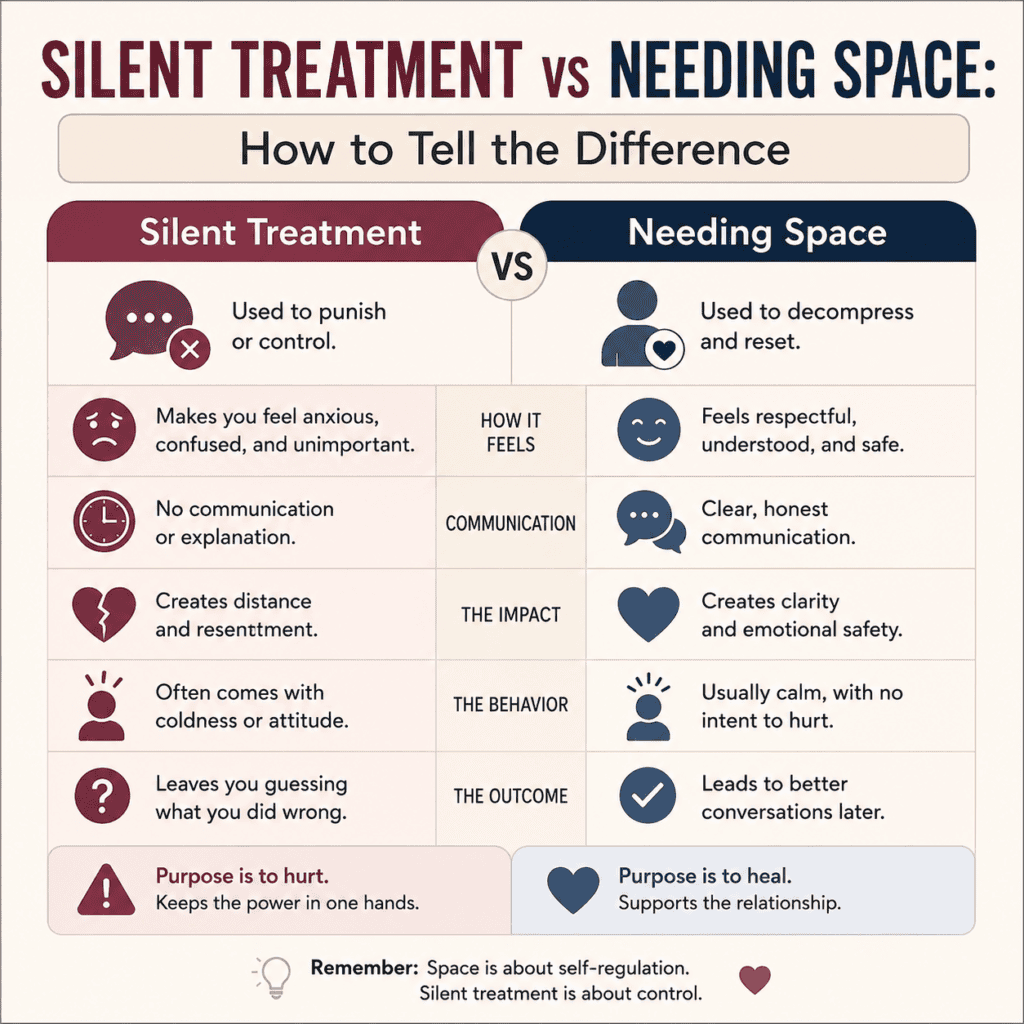
Use this when you are in the moment and struggling to tell which one you are dealing with:
Silent treatment indicators:
- No communication about needing time or space
- Duration tied to your behaviour rather than their regulation
- Extended beyond 24 hours
- Their demeanour seems pointed or performative
- Comprehensive — including practical communication
- Ends when you apologise or concede, not when they have regulated
- No return to the original issue when silence breaks
Genuine space need indicators:
- They communicated the need before going quiet
- They gave or implied a return time
- They are reachable for practical matters
- The duration is relatively short
- They return when regulated, regardless of your behaviour during the space
- They come back ready to continue the conversation
The Most Important Thing to Understand About Both
Whether your partner is giving you the silent treatment or genuinely needing space — the thing underneath it is almost always the same.
They do not know what to say.
The person giving the silent treatment cannot name their anger or hurt directly. The person who needs space cannot access their emotions while overwhelmed. Both of them are, in some version, stuck without the language for the moment.
And that is a solvable problem. It is a skills gap. A communication gap. A gap between what someone feels and the words they have available to express it.
The gap between feeling something and being able to say it clearly — in the moment it matters — is exactly what relationship communication tools exist to close.
When both partners have the exact words for these moments — when the person who needs space can say “I’m flooded, I need 20 minutes, I’ll be back” and actually mean it — when the person receiving the withdrawal can respond with warmth instead of pursuit — the dynamic changes entirely.
The silent treatment becomes less necessary. The genuine space need becomes less traumatising. The couple develops a shared language for the moments that used to produce shutdown or disappearance.
That is the work. And it starts with being able to tell the difference between silent treatment and needing space — which you now can.
Frequently Asked Questions: Silent Treatment vs Needing Space
How do I know if my partner is giving me the silent treatment or needs space?
The clearest indicator is communication — specifically, whether they said anything about needing time before going quiet. Someone who genuinely needs space almost always communicates the need, even briefly. Someone giving the silent treatment typically withdraws without explanation. Duration also matters — genuine regulation needs resolve within hours; the silent treatment can extend for days or weeks. And look at what their silence seems responsive to — if it softens when you apologise or pursue and extends when you seem unbothered, that responsiveness suggests silent treatment rather than a space need.
Is the silent treatment emotional abuse?
The silent treatment exists on a spectrum. In its milder forms, it is a dysfunctional but not abusive conflict strategy — often a learned behaviour from childhood that the person is using unconsciously. In its more extreme forms — particularly when it is prolonged, deliberate, and used systematically to punish or control — the silent treatment can cross into emotional abuse. The key factors are frequency, duration, intent, and the effect it has on the recipient’s wellbeing and sense of self. If you are regularly receiving the silent treatment and it is affecting your mental health, speaking with a therapist is worth considering.
How long should I give my partner space after an argument?
For genuine regulation needs, most nervous systems can return to an accessible state within 20 to 60 minutes. A few hours is understandable in particularly intense situations. If your partner has communicated they need space and given you a return time, honour that window. If no return time has been communicated and it has been more than a few hours, it is reasonable to send one calm, low-pressure message — something like “I’m here when you’re ready” — and then genuinely leave it.
What should I say when my partner gives me the silent treatment?
Say something once, calmly, without escalating. Something like: “I can see you’ve gone quiet. I’m not going to keep pushing — I just want you to know I’m here and I’d like to talk when you’re ready.” Then genuinely mean it and stop pursuing. Do not send repeated messages. Do not escalate to try to get a response. Do not apologise for things you did not do just to end the silence. Pursuing during the silent treatment usually extends it.
Why does my partner give me the silent treatment?
People give the silent treatment for several reasons — most of them rooted in the inability to express hurt or anger directly. They may have grown up in a household where the silent treatment was a normal conflict response and absorbed it as the default strategy. They may have avoidant attachment and find direct emotional expression overwhelming. They may use silence because past attempts to express anger verbally led to outcomes they found worse. Understanding the why matters — but it does not make the behaviour acceptable, and it does not mean it cannot change.
Is needing space the same as the silent treatment?
No — needing space and the silent treatment are meaningfully different, even though they can look similar from the outside. Needing space is a genuine regulation need — a flooded nervous system seeking time to return to an accessible state. The silent treatment is the deliberate withdrawal of communication as a form of punishment or leverage. The key differences are: whether the need was communicated, how long it lasts, what it seems responsive to, and what happens when the silence breaks. That said, genuine space needs that are not communicated clearly can land the same way the silent treatment does, even when the intention is different.
How do I stop giving my partner the silent treatment?
The first step is recognising that you are doing it — which is harder than it sounds, because many people who give the silent treatment genuinely believe they are just not ready to talk. Ask yourself honestly: am I withdrawing because I need to regulate, or am I withdrawing because I want them to feel the impact of what they did? If it is the latter, that is the silent treatment. The alternative is to find words for the anger or hurt directly — not perfectly, but genuinely.
Something like: “I’m really hurt right now and I’m struggling to talk. I’m not punishing you — I just need a short time and then I want to tell you what’s going on for me.” That is infinitely more connecting than disappearing.
What is the difference between stonewalling and the silent treatment?
Stonewalling and the silent treatment are related but distinct. Stonewalling — identified by John Gottman as one of the four most damaging relationship behaviours — typically occurs during conflict. The person shuts down mid-conversation, stops engaging, and becomes unresponsive. It is usually driven by emotional flooding. The silent treatment typically follows conflict and extends beyond it — it is the sustained withdrawal of communication as a consequence of the argument. Stonewalling is often involuntary; the silent treatment is usually more deliberate, even if unconsciously so.
The Bottom Line
Silent treatment vs needing space — this is one of the most important distinctions in relationship communication. And most couples have never had anyone lay it out clearly for them.
Here is what I want you to take from this article:
The silent treatment and genuine space needs look the same on the surface but come from completely different places and require completely different responses.
The silent treatment is silence used as a weapon, however unconsciously. Genuine space is a nervous system trying to regulate so it can come back to the conversation.
If you can tell the difference — and now you can — you can respond to each one in a way that actually helps rather than escalating the dynamic further.
And if your relationship has a recurring pattern involving either of these — the silent treatment or withdrawal that gets mistaken for it or that tips into it — that pattern has a name, a structure, and specific tools that can interrupt it.
You do not have to keep navigating this by improvising.
My Stop Miscommunication System gives couples the exact frameworks and word-for-word scripts for conflict de-escalation, withdrawal patterns, and the repair conversations that actually resolve things. The Secure Connection Blueprint for avoidant partners addresses the space needs and silent treatment patterns specifically — with 20 scripts for every withdrawal situation and a 30-day practice for building emotional availability.
Helpful thanks alot